


Page 252 - Geochemical Remote Sensing of The Sub-Surface
P. 252
Gas geochemistry surveys for petroleum                                225
                          Gauge
                                        ........ Septum
                Pump ~                 w
                       Vl(~    NaOH

                    V 3   I'T"  ~   ~   II
            HCi                    v4
                  V2


            Sample ......

                                  H-F-


            Water bath    '


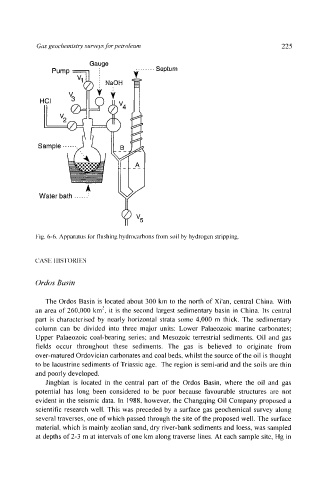
           i:ig. 6-6. Apparatus  lbr flushing hydrocarbons  t'ronl soil by hydrogen stripping.


           CASI'~ ! IIS'I'()RIES


           Ordos  Basin

              Tile  Ordos  Basin  is  located  about  300  km  to  the  north  of Xi'an,  central  China.  With
           an  area  of 260,000  km 2,  it  is  the  second  largest  sedimentary  basin  in  China.  Its  central
           part  is  characterised  by  nearly  horizontal  strata  some  4,000  m  thick.  The  sedimentary
           column  can  be  divided  into  three  major  units:  Lower  Palaeozoic  marine  carbonates:
           Upper  Palaeozoic  coal-bearing  series:  and  Mesozoic  terrestrial  sediments.  Oil  and  gas
           fields  occur  throughout  these  sediments.  The  gas  is  believed  to  originate  from
           over-matured Ordovician carbonates and coal beds, whilst the source of the oil  is thought
           to  be  lacustrine  sediments  of Triassic  age.  The  region  is semi-arid  and  the  soils  are  thin
           and poorly developed.
              Jingbian  is  located  in  the  central  part  of  the  Ordos  Basin,  where  the  oil  and  gas
           potential  has  long  been  considered  to  be  poor  because  favourable  structures  are  not
           evident  in  the  seismic  data.  In  1988,  however,  the  Changqing  Oil  Company  proposed  a
           scientific  research  well.  This  was  preceded  by  a  surface  gas  geochemical  survey  along
           several  traverses,  one of which  passed  through  the  site of the  proposed well.  The  surface
           material,  which  is mainly aeolian  sand,  dry river-bank sediments  and  loess,  was  sampled
           at depths  of 2-3  m at  intervals of one km  along traverse  lines.  At each  sample  site,  Hg  in

