


Page 247 - Geochemical Remote Sensing of The Sub-Surface
P. 247
220                                                       T. Ruan and Q. Fei

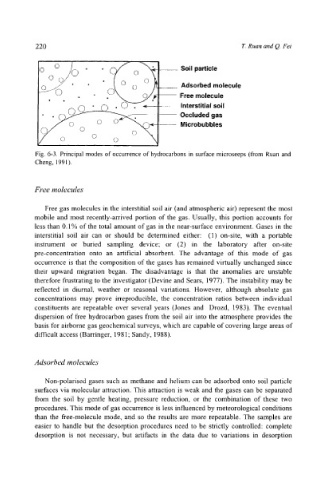
            o    o       .''.                       Soil  particle

                                                    Adsorbed  molecule
                                              I     Free  molecule

                                                    Interstitial  soil
                                                    Occluded  gas
                                                    Microbubbles
            [~    () ""  0  0  ,  o   o'~


           Fig.  6-3.  Principal  modes of occurrence  of hydrocarbons  in surface  microseeps  (from  Ruan  and
           Cheng,  1991 ).


           Free  molecules

              Free  gas  molecules  in the  interstitial  soil  air (and  atmospheric  air)  represent  the  most
           mobile  and  most  recently-arrived  portion  of  the  gas.  Usually,  this  portion  accounts  for
           less  than  0.1%  of the  total  amount  of gas  in  the  near-surface  environment.  Gases  in  the
           interstitial  soil  air  can  or  should  be  determined  either:  (1)  on-site,  with  a  portable
           instrument  or  buried  sampling  device;  or  (2)  in  the  laboratory  after  on-site
           pre-concentration  onto  an  artificial  absorbent.  The  advantage  of  this  mode  of  gas
           occurrence  is  that  the  composition  of the  gases  has  remained  virtually  unchanged  since
           their  upward  migration  began.  The  disadvantage  is  that  the  anomalies  are  unstable
           therefore  frustrating  to the  investigator  (Devine  and  Sears,  1977).  The  instability  may be
           reflected  in  diurnal,  weather  or  seasonal  variations.  However,  although  absolute  gas
           concentrations  may  prove  irreproducible,  the  concentration  ratios  between  individual
           constituents  are  repeatable  over  several  years  (Jones  and  Drozd,  1983).  The  eventual
           dispersion  of free  hydrocarbon  gases  from  the  soil  air  into  the  atmosphere  provides  the
           basis  for airborne  gas geochemical  surveys,  which  are  capable  of covering  large  areas  of
           difficult access (Barringer,  1981 ; Sandy,  1988).


           Adsorbed  molecules

              Non-polarised  gases  such  as  methane  and  helium  can  be  adsorbed  onto  soil  particle
           surfaces  via  molecular  attraction.  This  attraction  is weak  and  the  gases  can  be  separated
           from  the  soil  by  gentle  heating,  pressure  reduction,  or  the  combination  of  these  two
           procedures.  This  mode  of gas  occurrence  is less  influenced by  meteorological  conditions
           than  the  free-molecule  mode,  and  so  the  results  are  more  repeatable.  The  samples  are
           easier  to  handle  but  the  desorption  procedures  need  to  be  strictly  controlled:  complete
           desorption  is  not  necessary,  but  artifacts  in  the  data  due  to  variations  in  desorption

