


Page 242 - Geochemical Remote Sensing of The Sub-Surface
P. 242
Gas geochemistry surveys for petroleum                                215


                              [  ~c~  ~oc.~,c~ ~~..~  ]


                          DETECTION  TECHNIQUES AND INSTRUMENTATION


                                iNDICATORS AND PARAMETERS


                    .-~   ~0  ~


                                         l                    I
                                     /    "x


                                       1_...,
            iDIAPIRISM  AN] ICLINE  LITitOLOGY  FAUI.T   PALEO-  [  THRUSTS   ttYDRO-
                                          CON F'ORMITY MORPitO LOG Y   DYNA MIC
             -                        ~
                 ""              ttYDROCARBON SOURCES

                 SHALLOW BIOGENIC  GAS  COALBED  GAS   THERMAL  GAS  OVER MATURED GAS

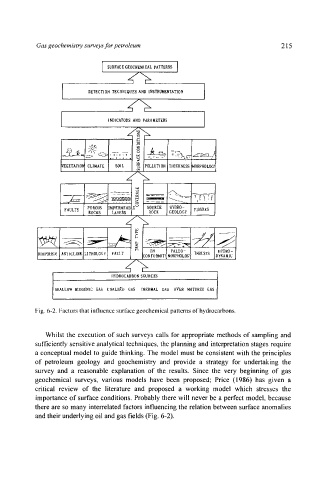
           Fig. 6-2. l:actors that intlucnce surthcc gcochelnical patterns of hydrocarbons.


              Whilst the  execution  of such  surveys calls  for appropriate  methods  of sampling  and
           sufficiently sensitive analytical techniques,  the planning and  interpretation  stages  require
           a conceptual  model  to guide thinking.  The  model  must  be consistent  with  the  principles
           of  petroleum  geology  and  geochemistry  and  provide  a  strategy  for  undertaking  the
           survey  and  a  reasonable  explanation  of  the  results.  Since  the  very  beginning  of  gas
           geochemical  surveys,  various  models  have  been  proposed;  Price  (1986)  has  given  a
           critical  review  of  the  literature  and  proposed  a  working  model  which  stresses  the
           importance  of surface  conditions.  Probably there  will  never be a  perfect  model,  because
           there are so many interrelated  factors  influencing the relation between  surface  anomalies
           and their underlying oil and gas fields (Fig. 6-2).

