


Page 241 - Geochemical Remote Sensing of The Sub-Surface
P. 241
214                                                       T.  Ruan and Q.  Fei

                   i~ ~ :-!; r~;;, ~, ;:: IF, i:i i z, :;::~ =::r~: :: ~:s: :,,~,: J:s a~;:::~.:~= ~::n= ~:!: !~  ~.~.~. :!~.~!i! i~ ~!!"y .~! ~: ~  !~ ~: ~  !~.~: ~  ~, ~  ,~ i~ ~': ~ ~!r. ~: ~i~i~  ~   9 ~ ~  r
                                                       ~
                                           A
                     SURFACE EOCHEMICAL NOMALIES ~
                              G
                            -  DESTRUCTION ~Ii!i
                                               !
                     .....   i{   .......   ' ...............   ..........................
                               -
                                    I
                               DISPERSION

                                    I
                            .......... ~ ...................................  1 .............................................   ~


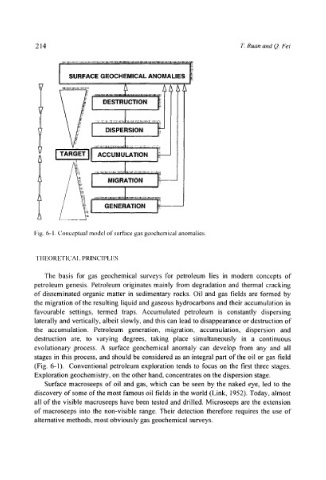
           Fig. 6-1. Conceptual model ot'surtace gas geochemical anomalies.


           '!'t IF.ORETICAI. PRINCIPI~I']S

              The  basis  for  gas  geochemical  surveys  for  petroleum  lies  in  modern  concepts  of
           petroleum  genesis.  Petroleum  originates  mainly  from  degradation  and  thermal  cracking
           of disseminated  organic  matter  in  sedimentary  rocks.  Oil  and  gas  fields  are  formed  by
           the migration of the resulting  liquid and gaseous hydrocarbons and their accumulation  in
           favourable  settings,  termed  traps.  Accumulated  petroleum  is  constantly  dispersing
           laterally and vertically, albeit slowly, and this can  lead to disappearance  or destruction of
           the  accumulation.  Petroleum  generation,  migration,  accumulation,  dispersion  and
           destruction  are,  to  varying  degrees,  taking  place  simultaneously  in  a  continuous
           evolutionary  process.  A  surface  geochemical  anomaly  can  develop  from  any  and  all
           stages  in this process,  and  should be considered  as an  integral  part of the  oil or gas  field
           (Fig.  6-1).  Conventional  petroleum  exploration  tends  to  focus  on  the  first  three  stages.
           Exploration geochemistry, on the other hand, concentrates on the dispersion stage.
              Surface  macroseeps  of oil  and  gas,  which  can  be  seen  by  the  naked  eye,  led  to  the
           discovery of some of the most famous oil fields in the world (Link,  1952).  Today, almost
           all  of the  visible  macroseeps  have  been  tested  and  drilled.  Microseeps  are the  extension
           of macroseeps  into  the  non-visible  range.  Their  detection  therefore  requires  the  use  of
           alternative methods, most obviously gas geochemical surveys.

