


Page 270 - Geochemical Remote Sensing of The Sub-Surface
P. 270
Aerospace detection of hydrocarbon-induced alteration                243

           climax.  The  maple  trees  occur  in  an  area  of maximum  methane  seepage  and  minimum
           soil  oxygen  content.  The  symbiotic  mycorrhizal  fungi  on  the  root  hairs  of maple  trees
           appear  better  able  to  tolerate  these  anaerobic  soils  than  their  counterparts  on  the  root
           hairs  of  oaks.  Lang  et  al.  (1985b)  searched  the  NS-001  data  for  information  on  the
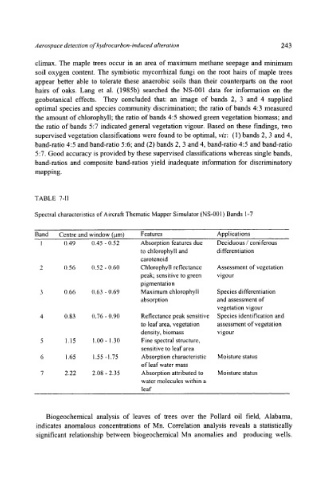
           geobotanical  effects.  They  concluded  that:  an  image  of  bands  2,  3  and  4  supplied
           optimal  species  and  species  community  discrimination;  the  ratio  of bands  4:3  measured
           the  amount  of chlorophyll;  the ratio  of bands  4:5  showed  green vegetation biomass;  and
           the  ratio  of bands  5:7  indicated  general  vegetation  vigour.  Based  on  these  findings,  two
           supervised vegetation classifications were found to be optimal,  viz:  (1) bands  2,  3  and 4,
           band-ratio 4:5  and band-ratio  5:6;  and (2) bands  2, 3 and 4, band-ratio 4:5  and band-ratio
           5:7.  Good accuracy is provided by these  supervised  classifications  whereas  single bands,
           band-ratios  and  composite  band-ratios  yield  inadequate  information  for  discriminatory
           mapping.


           TABLE  7-1I

           Spectral  characteristics of Aircraft Thematic Mapper Simulator (NS-001) Bands  1-7


           Band   Centre and window (lam)   Features          Applications
             1     0.49    0.45 - 0.52   Absorption  features due   Deciduous / coniferous
                                         to chlorophyll  and   differentiation
                                         carotenoid
             2     0.56    0.52 - 0.60   Chlorophyll  reflectance   Assessment of vegetation
                                         peak; sensitive to green   vigour
                                         pigmentation
             3     0.66    0.63 -0.69    Maximum chlorophyll   Species differentiation
                                         absorption           and assessment of
                                                              vegetation vigour
             4     0.83    0.76 - 0.90   Reflectance peak sensitive   Species identification  and
                                         to leaf area, vegetation   assessment of vegetation
                                         density,  biomass    vigour
             5      1.15   1.00 - 1.30   Fine spectral structure,
                                         sensitive to leaf area
             6      1.65   1.55 -I.75    Absorption  characteristic   Moisture  status
                                         of leaf water mass
             7      2.22   2.08 - 2.35   Absorption  attributed to   Moisture status
                                         water molecules within a
                                         leaf


              Biogeochemical  analysis  of  leaves  of  trees  over  the  Pollard  oil  field,  Alabama,
           indicates  anomalous  concentrations  of  Mn.  Correlation  analysis  reveals  a  statistically
           significant  relationship  between  biogeochemical  Mn  anomalies  and  producing  wells.

