


Page 269 - Geochemical Remote Sensing of The Sub-Surface
P. 269
242                                       H.  Yang, F.D.  Van der Meer and J. Zhang

                 50   - -  Blue  =  400-500  nm
                        Green  =  500-600  nm
                    -   Red   =  600-700  nm
                        Infrared  =  700-1100  nm
                 40

           o-e
           v     30   --                      ,s  S''~--!   . . . . . . . . . .
            CD
            O
            t---
           "6                             II I
            CD
                 20
           rv'             (Lp)  Blue  shift


                 10


                                     Ro
                                 i      i      I   ~J       1
                 0
                   400   500    600   i   700   800   900   1000   1100
                       -  -
                                    Wavelength (rim)
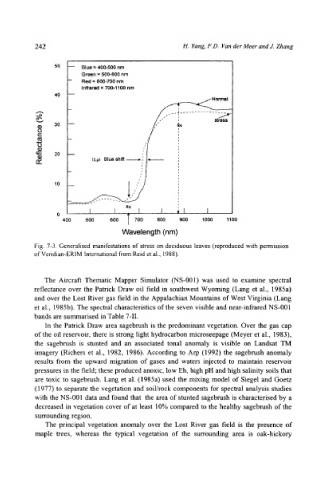
           Fig. 7-3. Generalised  manifestations  of stress on deciduous  leaves (reproduced  with permission
           of Veridian-ERIM  International from Reid et al., 1988).


              The  Aircraft  Thematic  Mapper  Simulator  (NS-001)  was  used  to  examine  spectral
           reflectance  over  the  Patrick  Draw  oil  field  in  southwest  Wyoming  (Lang  et  al.,  1985a)
           and  over the  Lost River  gas  field  in the  Appalachian  Mountains  of West Virginia  (Lang
           et al.,  1985b).  The  spectral  characteristics  of the  seven  visible  and near-infrared  NS-001
           bands  are summarised  in Table 7-11.
              In  the  Patrick  Draw  area  sagebrush  is the  predominant  vegetation.  Over  the  gas  cap
           of the  oil reservoir,  there  is strong  light hydrocarbon  microseepage  (Meyer et al.,  1983),
           the  sagebrush  is  stunted  and  an  associated  tonal  anomaly  is  visible  on  Landsat  TM
           imagery  (Richers  et  al.,  1982,  1986).  According  to  Arp  (1992)  the  sagebrush  anomaly
           results  from  the  upward  migration  of  gases  and  waters  injected  to  maintain  reservoir
           pressures  in the field; these produced  anoxic,  low Eh, high pH and high salinity soils that
           are  toxic  to  sagebrush.  Lang  et  al.  (1985a)  used  the  mixing  model  of Siegel  and  Goetz
           (1977)  to  separate  the  vegetation  and  soil/rock  components  for  spectral  analysis  studies
           with the NS-001  data  and found  that  the  area of stunted  sagebrush  is characterised  by  a
           decreased  in vegetation  cover  of at least  10%  compared  to the  healthy  sagebrush  of the
           surrounding region.
              The  principal  vegetation  anomaly  over  the  Lost  River  gas  field  is  the  presence  of
           maple  trees,  whereas  the  typical  vegetation  of  the  surrounding  area  is  oak-hickory

