


Page 264 - Geochemical Remote Sensing of The Sub-Surface
P. 264
Aerospace detection of hydrocarbon-induced alteration                23 7


           characteristics  can  be  used  in  remote  sensing  data-processing  to  separate  bleached  red
           beds  from their unbleached equivalents.
              In  the  Cement  oil-field  area  of Oklahoma,  Donovan  (1974)  reported  that  the  colour
           of  the  Permian  Rush  Springs  formation  grades  from  reddish-brown  for  unaltered
           sandstone  adjacent to the field,  to pink,  yellow and white along the  flanks  of the Cement
           anticline,  then  to  white  along  the  flanks  of the  anticlinal  axis.  The  white  colour reflects
           maximum bleaching  and maximum iron loss.  Similar changes  are observed at the nearby
           Velma,  Eola,  Healdton,  and  Chickaska  fields  (Ferguson,  1979a,  1979b;  Donovan  et  al.,
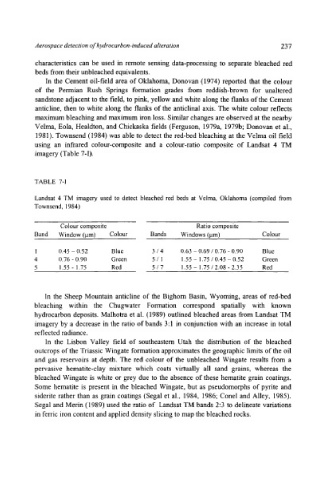
           1981).  Townsend  (1984)  was  able  to detect the  red-bed bleaching  at the  Velma  oil  field
           using  an  infrared  colour-composite  and  a  colour-ratio  composite  of  Landsat  4  TM
           imagery (Table  7-I).


           TABLE  7-I

           Landsat  4  TM  imagery  used to  detect  bleached  red  beds  at  Veima, Oklahoma  (compiled  from
           Townsend,  1984)

                  Colour composite                       Ratio composite
           Band   Window (~tm)   Colour     Bands   Windows (I.tm)         Colour

           1      0.45 -  0.52   Blue       3 / 4   0.63 -  0.69 / 0.76 - 0.90   Blue
           4      0.76 - 0.90    Green      5 /  !   1.55 -  1.75 / 0.45 -  0.52   Green
           5      1.55 - 1.75    Red        5 / 7   !.55 -  1.75 / 2.08 - 2.35   Red


              In  the  Sheep  Mountain  anticline  of the  Bighorn  Basin,  Wyoming,  areas  of red-bed
           bleaching  within  the  Chugwater  Formation  correspond  spatially  with  known
           hydrocarbon  deposits.  Malhotra  et  al.  (1989)  outlined  bleached  areas  from  Landsat  TM
           imagery  by  a  decrease  in the  ratio  of bands  3:1  in  conjunction  with  an  increase  in  total
           reflected radiance.
              In  the  Lisbon  Valley  field  of  southeastern  Utah  the  distribution  of  the  bleached
           outcrops of the  Triassic  Wingate  formation approximates the geographic  limits of the oil
           and  gas  reservoirs  at  depth.  The  red  colour  of  the  unbleached  Wingate  results  from  a
           pervasive  hematite-clay  mixture  which  coats  virtually  all  sand  grains,  whereas  the
           bleached  Wingate  is  white  or  grey  due  to  the  absence  of these  hematite  grain  coatings.
           Some  hematite  is  present  in  the  bleached  Wingate,  but  as  pseudomorphs  of pyrite  and
           siderite  rather  than  as  grain  coatings  (Segal  et  al.,  1984,  1986;  Conel  and  Alley,  1985).
           Segal  and Merin  (1989)  used  the  ratio  of  Landsat  TM  bands  2:3  to  delineate  variations
           in ferric  iron content and applied density slicing to map the bleached rocks.

