


Page 262 - Geochemical Remote Sensing of The Sub-Surface
P. 262
Aerospace detection of hydrocarbon-induced alteration                235


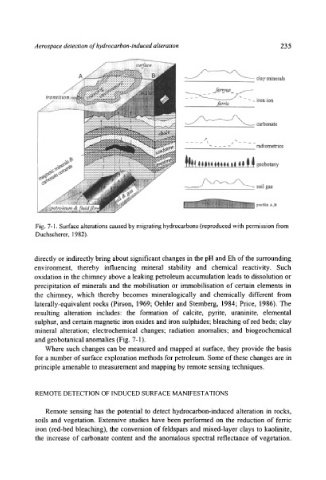
           Fig. 7-1. Surface alterations caused by migrating hydrocarbons (reproduced with permission from
           Duchscherer, 1982).


           directly or indirectly bring about significant changes in the pH and Eh of the surrounding
           environment,  thereby  influencing  mineral  stability  and  chemical  reactivity.  Such
           oxidation in the chimney above a leaking petroleum accumulation leads to dissolution  or
           precipitation  of minerals  and  the  mobilisation  or  immobilisation  of certain  elements  in
           the  chimney,  which  thereby  becomes  mineralogically  and  chemically  different  from
           laterally-equivalent  rocks  (Pirson,  1969; Oehler and  Stemberg,  1984; Price,  1986).  The
           resulting  alteration  includes:  the  formation  of  calcite,  pyrite,  uraninite,  elemental
           sulphur,  and certain magnetic  iron oxides and iron sulphides; bleaching of red beds; clay
           mineral  alteration;  electrochemical  changes;  radiation  anomalies;  and  biogeochemical
           and geobotanical anomalies (Fig. 7-1).
              Where  such changes can be measured and mapped  at surface,  they provide  the  basis
           for a number of surface exploration methods for petroleum.  Some of these changes are in
           principle amenable to measurement and mapping by remote sensing techniques.


           REMOTE DETECTION OF INDUCED SURFACE MANIFESTATIONS

              Remote  sensing  has  the  potential  to  detect hydrocarbon-induced  alteration  in  rocks,
           soils  and  vegetation.  Extensive  studies  have  been performed  on  the  reduction  of ferric
           iron (red-bed bleaching),  the conversion of feldspars  and mixed-layer clays to kaolinite,
           the  increase  of carbonate  content  and the  anomalous  spectral  reflectance  of vegetation.

