


Page 263 - Geochemical Remote Sensing of The Sub-Surface
P. 263
236                                       tl.  Yang, F.D. Van der Meet and,1. Zhang

           The  attraction  of  remote  sensing  is  that  it  offers  a  rapid  and  cost-effective  means  of
           conducting reconnaissance  for hydrocarbon-induced  alteration.


           Bleached  red beds

              The presence  at surface  of bleached  and discoloured  red sandstones  above  petroleum
           accumulation  has  been  widely  noted,  but  detailed  studies  are  few.  Bleaching  occurs
           whenever  acidic,  reducing  fluids  dissolve  the  ferric  oxide  (hematite)  that  gives  the  red
           bed  its characteristic  colour.  Reducing conditions  also favour the  formation  of pyrite and
           siderite  from  the  iron  that  is  released  during  the  dissolution  of hematite.  Leakage  from
           petroleum  accumulations  of reducing  agents  such  as  hydrocarbons,  H2S  and  CO 2 could
           be responsible  for bleaching overlying red beds (Schumacher,  1996).
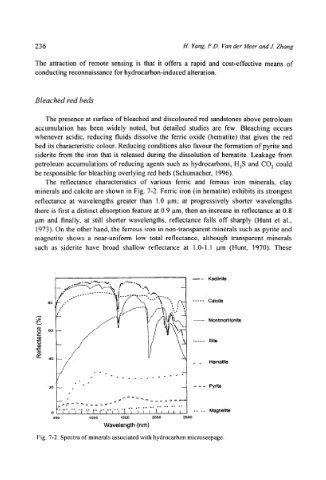
              The  reflectance  characteristics  of  various  ferric  and  ferrous  iron  minerals,  clay
           minerals and calcite  are shown  in Fig.  7-2.  Ferric  iron (in hematite)  exhibits  its strongest
           reflectance  at  wavelengths  greater  than  1.0  pm;  at  progressively  shorter  wavelengths
           there  is first a distinct absorption  feature  at 0.9  [am, then  an  increase  in reflectance  at 0.8
           ~tm  and  finally,  at  still  shorter  wavelengths,  reflectance  falls  off  sharply  (Hunt  et  al.,
           1973).  On the other hand,  the ferrous  iron  in non-transparent  minerals  such  as pyrite  and
           magnetite  shows  a  near-uniform  low  total  reflectance,  although  transparent  minerals
           such  as  siderite  have  broad  shallow  reflectance  at  1.0-1.1  ~tm  (Hunt,  1970).  These


                 '-                                 ~   ---..   Kaolinite

                  _,               '       ""~  ~  "",   :-   .....   Calcite
               80
                  ""
                   9               9         -  .... i"..  :"-''.
                                                            Montmorillonite
            ~   80
                    .f./                                ..........  lURe


           ~  ,o
                                                        .   .   Hematite


               20     '''                               ---   Pyrite


                o  "T"l"l   "r  "1"  ]'"  I'"  I"l"l   "]  "l"  "i"  i'l   I"1   I   ....   Magnetite
                40(       1000     1500     2000     2500
                              Wavelength  (nm)
            Fig. 7-2. Spectra of minerals associated with hydrocarbon microseepage.

