


Page 266 - Geothermal Energy Renewable Energy and The Environment
P. 266
256                          Geothermal Energy: Renewable Energy and the Environment


                               14.0

                               12.0
                                                      Range of generation cost
                                                     for producing geothermal
                               10.0                         power

                                                         Levelized cost
                              Cents/kWh  6.0
                               8.0
                                                        for geothermal

                                    Cost of generating power
                               4.0     from fossil fuels


                               2.0

                                0.0
                                1975  1980  1985  1990  1995  2000  2005  2010
                                                    Year
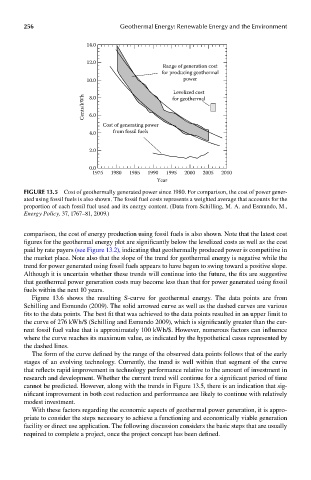
            FIGUre 13.5  Cost of geothermally generated power since 1980. For comparison, the cost of power gener-
            ated using fossil fuels is also shown. The fossil fuel costs represents a weighted average that accounts for the
            proportion of each fossil fuel used and its energy content. (Data from Schilling, M. A. and Esmundo, M.,
            Energy Policy, 37, 1767–81, 2009.)


            comparison, the cost of energy production using fossil fuels is also shown. Note that the latest cost
            figures for the geothermal energy plot are significantly below the levelized costs as well as the cost
            paid by rate payers (see Figure 13.2), indicating that geothermally produced power is competitive in
            the market place. Note also that the slope of the trend for geothermal energy is negative while the
            trend for power generated using fossil fuels appears to have begun to swing toward a positive slope.
            Although it is uncertain whether these trends will continue into the future, the fits are suggestive
            that geothermal power generation costs may become less than that for power generated using fossil
            fuels within the next 10 years.
              Figure  13.6  shows  the  resulting  S-curve  for  geothermal  energy.  The  data  points  are  from
            Schilling and Esmundo (2009). The solid arrowed curve as well as the dashed curves are various
            fits to the data points. The best fit that was achieved to the data points resulted in an upper limit to
            the curve of 276 kWh/$ (Schilling and Esmundo 2009), which is significantly greater than the cur-
            rent fossil fuel value that is approximately 100 kWh/$. However, numerous factors can influence
            where the curve reaches its maximum value, as indicated by the hypothetical cases represented by
            the dashed lines.
              The form of the curve defined by the range of the observed data points follows that of the early
            stages of an evolving technology. Currently, the trend is well within that segment of the curve
            that reflects rapid improvement in technology performance relative to the amount of investment in
            research and development. Whether the current trend will continue for a significant period of time
            cannot be predicted. However, along with the trends in Figure 13.5, there is an indication that sig-
            nificant improvement in both cost reduction and performance are likely to continue with relatively
            modest investment.
              With these factors regarding the economic aspects of geothermal power generation, it is appro-
            priate to consider the steps necessary to achieve a functioning and economically viable generation
            facility or direct use application. The following discussion considers the basic steps that are usually
            required to complete a project, once the project concept has been defined.

