


Page 435 - Global Tectonics
P. 435
IMPLICATIONS OF PLATE TECTONICS  417


                                      Sediment          Seafloor spreading  0    Layer 1:
                                                                                 sediment
                             Metalliferous sediment           Axis
                   (Cu, Fe, Mn, Pb, Pb, Zn, Ba, Co, Ag, Au)                      Layer 2:
                        Stratiform oxides, hydroxides,                           mafic rocks
                                 silicates (Fe, Mn)                              (basalt)
                          Massive, disseminated, and                         Thickness (km)  Layer 3:
                   stockwork sulfides (Cu, Fe, Zn, Ag, Au)                       mafic and
                                         Dikes                            5      ultramafic rocks
                            Gabbro and serpentinite                              Upper mantle:
                                                                                 ultramafic rocks
                                     Cumulates
                                      Chromite
                           Lherzolite and harzburgite
                         Nickel and platinum sulfides
                                              0
                                                          5
                                                                    10
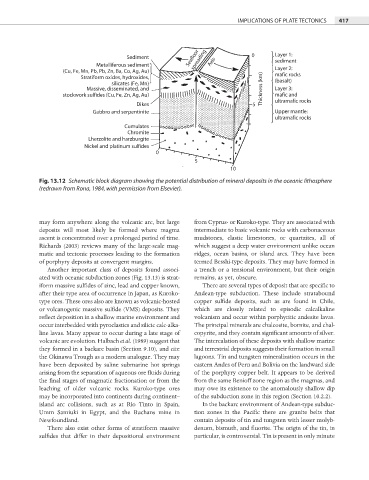
            Fig. 13.12  Schematic block diagram showing the potential distribution of mineral deposits in the oceanic lithosphere
            (redrawn from Rona, 1984, with permission from Elsevier).


            may form anywhere along the volcanic arc, but large   from Cyprus- or Kuroko-type. They are associated with
            deposits will most likely be formed where magma   intermediate to basic volcanic rocks with carbonaceous
            ascent is concentrated over a prolonged period of time.   mudstones, clastic limestones, or quartzites, all of
            Richards (2003) reviews many of the large-scale mag-  which suggest a deep water environment unlike ocean
            matic and tectonic processes leading to the formation   ridges, ocean basins, or island arcs. They have been
            of porphyry deposits at convergent margins.  termed Besshi-type deposits. They may have formed in
               Another important class of deposits found associ-  a trench or a tensional environment, but their origin
            ated with oceanic subduction zones (Fig. 13.13) is strat-  remains, as yet, obscure.
            iform massive sulfi des of zinc, lead and copper known,   There are several types of deposit that are specifi c to
            after their type area of occurrence in Japan, as Kuroko-  Andean-type subduction. These include stratabound
            type ores. These ores also are known as volcanic-hosted   copper sulfide deposits, such as are found in Chile,


            or volcanogenic massive sulfide (VMS) deposits. They   which are closely related to episodic calcalkaline

            reflect deposition in a shallow marine environment and   volcanism and occur within porphyritic andesite lavas.
            occur interbedded with pyroclastics and silicic calc-alka-  The principal minerals are chalcosite, bornite, and chal-
            line lavas. Many appear to occur during a late stage of   copyrite, and they contain significant amounts of silver.

            volcanic arc evolution. Halbach et al. (1989) suggest that   The intercalation of these deposits with shallow marine
            they formed in a backarc basin (Section 9.10), and cite   and terrestrial deposits suggests their formation in small
            the Okinawa Trough as a modern analogue. They may   lagoons. Tin and tungsten mineralization occurs in the
            have been deposited by saline submarine hot springs   eastern Andes of Peru and Bolivia on the landward side
            arising from the separation of aqueous ore fl uids during   of the porphyry copper belt. It appears to be derived
            the final stages of magmatic fractionation or from the   from the same Benioff zone region as the magmas, and

            leaching of older volcanic rocks. Kuroko-type ores   may owe its existence to the anomalously shallow dip
            may be incorporated into continents during continent–  of the subduction zone in this region (Section 10.2.2).
            island arc collisions, such as at Río Tinto in Spain,   In the backarc environment of Andean-type subduc-

            Umm Samiuki in Egypt, and the Buchans mine in   tion zones in the Pacific there are granite belts that
            Newfoundland.                                contain deposits of tin and tungsten with lesser molyb-
               There also exist other forms of stratiform massive   denum, bismuth, and fluorite. The origin of the tin, in


            sulfides that differ in their depositional environment   particular, is controversial. Tin is present in only minute

