


Page 436 - Global Tectonics
P. 436
418   CHAPTER 13


                                      Outer arc       Arc             Basin

                                              Podiform chromite  Position of possible
                                                                spreading axis with
                        Mélange with                            Cyprus-type deposits
                        oceanic sulfide           Besshi-type
                        deposit                   massive sulfides
             Oceanic sulfide                      Porphyry copper ore
             deposits
             [Cyprus-type]                              Kuroko-type               Plutons with
             being transported                          massive                   Sn, W, Bi veins
             in oceanic crust                           sulfides
                                                                                       Continental
                Oceanic crust                    Batholiths        Oceanic crust       crust
               Descending lithospheric
                      plate
                                                           Ascending
                                                           calc-alkaline
                                                           magma

                  Asthenosphere
                                                Partial melting


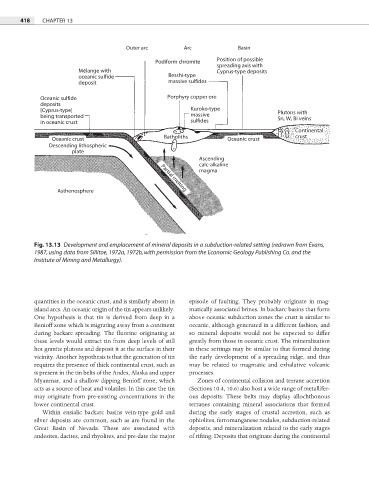
           Fig. 13.13  Development and emplacement of mineral deposits in a subduction-related setting (redrawn from Evans,
           1987, using data from Sillitoe, 1972a, 1972b, with permission from the Economic Geology Publishing Co. and the
           Institute of Mining and Metallurgy).


           quantities in the oceanic crust, and is similarly absent in   episode of faulting. They probably originate in mag-
           island arcs. An oceanic origin of the tin appears unlikely.   matically associated brines. In backarc basins that form
           One hypothesis is that tin is derived from deep in a   above oceanic subduction zones the crust is similar to
           Benioff zone which is migrating away from a continent   oceanic, although generated in a different fashion, and

           during backarc spreading. The fluorine originating at   so mineral deposits would not be expected to differ
           these levels would extract tin from deep levels of still   greatly from those in oceanic crust. The mineralization
           hot granite plutons and deposit it at the surface in their   in these settings may be similar to that formed during
           vicinity. Another hypothesis is that the generation of tin   the early development of a spreading ridge, and thus
           requires the presence of thick continental crust, such as   may be related to magmatic and exhalative volcanic
           is present in the tin belts of the Andes, Alaska and upper   processes.
           Myanmar, and a shallow dipping Benioff zone, which   Zones of continental collision and terrane accretion
           acts as a source of heat and volatiles. In this case the tin   (Sections 10.4, 10.6) also host a wide range of metallifer-
           may originate from pre-existing concentrations in the   ous deposits. These belts may display allochthonous
           lower continental crust.                     terranes containing mineral associations that formed
             Within ensialic backarc basins vein-type gold and   during the early stages of crustal accretion, such as
           silver deposits are common, such as are found in the   ophiolites, ferromanganese nodules, subduction-related
           Great Basin of Nevada. These are associated with   deposits, and mineralization related to the early stages
           andesites, dacites, and rhyolites, and pre-date the major   of rifting. Deposits that originate during the continental

