


Page 277 -
P. 277
P
                                T
                248   P a r t   V :  a r t   V :    T h e   G r e e n i n g   P r o c e s sh e   G r e e n i n g   P r o c e s s
                248
                      Cons
                          •  Metadata is hard to update in switch-based devices.
                          •  Out-of-band requires specific host-based software.
                          •  In-band may add latency to I/O.

                      Implementation
                      Implementing network virtualization involves either a standalone appliance (appliance based)
                      or a switch (switch based). Both architectures give the same services—pooling, data
                      migration, and so forth.

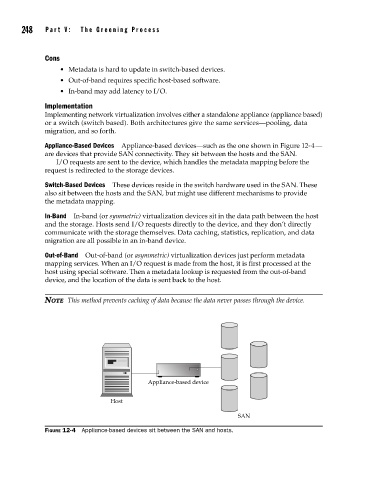
                      Appliance-Based Devices  Appliance-based devices—such as the one shown in Figure 12-4 —
                      are devices that provide SAN connectivity. They sit between the hosts and the SAN.
                         I/O requests are sent to the device, which handles the metadata mapping before the
                      request is redirected to the storage devices.
                      Switch-Based Devices  These devices reside in the switch hardware used in the SAN. These
                      also sit between the hosts and the SAN, but might use different mechanisms to provide
                      the metadata mapping.

                      In-Band  In-band (or symmetric) virtualization devices sit in the data path between the host
                      and the storage. Hosts send I/O requests directly to the device, and they don’t directly
                      communicate with the storage themselves. Data caching, statistics, replication, and data
                      migration are all possible in an in-band device.

                      Out-of-Band  Out-of-band (or asymmetric) virtualization devices just perform metadata
                      mapping services. When an I/O request is made from the host, it is first processed at the
                      host using special software. Then a metadata lookup is requested from the out-of-band
                      device, and the location of the data is sent back to the host.


                      NOTE  This method prevents caching of data because the data never passes through the device.


                                                   Appliance-based device

                                        Host

                                                                            SAN
                      FIGURE 12-4  Appliance-based devices sit between the SAN and hosts.

