


Page 279 -
P. 279
P
                250
                250   P a r t   V :  a r t   V :    T T h e   G r e e n i n g   P r o c e s sh e   G r e e n i n g   P r o c e s s

                         However, for organizations that haven’t embraced the concept, the result is more
                      expense and more energy usage. For instance, many businesses deploy the fastest—and
                      most power-hungry—Fibre Channel disk drives in a single tier. All the organization’s data
                      is in that pool, which is great for the current data, but the Third Quarter Operations
                      Department Report from 1997 doesn’t need to be on such a system.
                         Compellent takes the person out of the process with its automated tiered storage
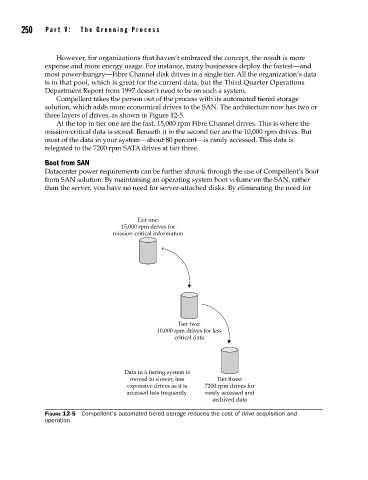
                      solution, which adds more economical drives to the SAN. The architecture now has two or
                      three layers of drives, as shown in Figure 12-5.
                         At the top in tier one are the fast, 15,000 rpm Fibre Channel drives. This is where the
                      mission-critical data is stored. Beneath it in the second tier are the 10,000 rpm drives. But
                      most of the data in your system—about 80 percent—is rarely accessed. This data is
                      relegated to the 7200 rpm SATA drives at tier three.

                      Boot from SAN
                      Datacenter power requirements can be further shrunk through the use of Compellent’s Boot
                      from SAN solution. By maintaining an operating system boot volume on the SAN, rather
                      than the server, you have no need for server-attached disks. By eliminating the need for


                                                Tier one:
                                           15,000 rpm drives for
                                         mission-critical information


                                                           Tier two:
                                                     10,000 rpm drives for less
                                                          critical data


                                            Data in a tiering system is
                                              moved to slower, less   Tier three:
                                             expensive drives as it is  7200 rpm drives for
                                             accessed less frequently.  rarely accessed and
                                                                     archived data
                      FIGURE 12-5  Compellent’s automated tiered storage reduces the cost of drive acquisition and
                      operation.

