


Page 329 - HVAC Pump Handbook
P. 329
Rishel_CH11.qxd  20/4/06  6:37 PM  Page 326


                                         Open Cooling Tower Pumps

                    326   Pumps for Open HVAC Cooling Systems

                    minute with a specific temperature difference between inlet and out-
                    let temperatures.
                      A detailed description of cooling tower performance is beyond the
                    scope of this book. This chapter will be devoted to the piping and pump-
                    ing of cooling towers and chiller condensers and how their performance
                    affects cooling tower pumps and vice versa. The next chapter will deal
                    with process cooling using cooling towers and other equipment.
                      For a detailed description of the thermodynamics of cooling towers
                    and a comprehensive discussion of the various types of cooling towers,
                    the reader is encouraged to study Cooling Tower (Chap. 36 of the
                    Systems and Equipment volume of the ASHRAE Handbook for
                    Heating, Ventilating and Air-Conditioning, 2004.
                      Obviously, there are a number of different arrangements of cooling
                    tower fill and air patterns to achieve the most efficient and economi-
                    cally feasible cooling tower for the many different sizes and types of
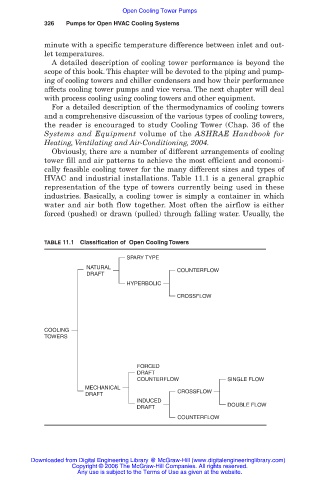
                    HVAC and industrial installations. Table 11.1 is a general graphic
                    representation of the type of towers currently being used in these
                    industries. Basically, a cooling tower is simply a container in which
                    water and air both flow together. Most often the airflow is either
                    forced (pushed) or drawn (pulled) through falling water. Usually, the


                    TABLE 11.1 Classification of  Open Cooling Towers
                                          SPARY TYPE
                                NATURAL                 COUNTERFLOW
                                DRAFT
                                          HYPERBOLIC
                                                        CROSSFLOW


                    COOLING
                    TOWERS


                                             FORCED
                                             DRAFT
                                             COUNTERFLOW              SINGLE FLOW
                               MECHANICAL
                                                        CROSSFLOW
                               DRAFT
                                             INDUCED
                                             DRAFT                    DOUBLE FLOW
                                                        COUNTERFLOW


                 Downloaded from Digital Engineering Library @ McGraw-Hill (www.digitalengineeringlibrary.com)
                            Copyright © 2006 The McGraw-Hill Companies. All rights reserved.
                             Any use is subject to the Terms of Use as given at the website.

