


Page 686 - Handbook Of Integral Equations
P. 686
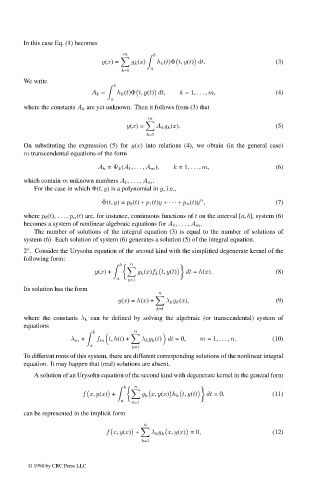
In this case Eq. (1) becomes

                                              m         b


                                       y(x)=    g k (x)  h k (t)Φ t, y(t) dt.               (3)
                                                      a
                                             k=1
               We write
                                            b

                                    A k =   h k (t)Φ t, y(t) dt,  k =1, ... , m,            (4)
                                          a
               where the constants A k are yet unknown. Then it follows from (3) that
                                                     m

                                               y(x)=    A k g k (x).                        (5)
                                                     k=1
               On substituting the expression (5) for y(x) into relations (4), we obtain (in the general case)
               m transcendental equations of the form

                                      A k = Ψ k (A 1 , ... , A m ),  k =1, ... , m,         (6)

               which contain m unknown numbers A 1 , ... , A m .
                   For the case in which Φ(t, y) is a polynomial in y, i.e.,
                                                                     n
                                       Φ(t, y)= p 0 (t)+ p 1 (t)y + ··· + p n (t)y ,        (7)
               where p 0 (t), ... , p n (t) are, for instance, continuous functions of t on the interval [a, b], system (6)
               becomes a system of nonlinear algebraic equations for A 1 , ... , A m .
                   The number of solutions of the integral equation (3) is equal to the number of solutions of
               system (6). Each solution of system (6) generates a solution (5) of the integral equation.
                ◦
               2 . Consider the Urysohn equation of the second kind with the simplified degenerate kernel of the
               following form:
                                              n
                                            b

                                     y(x)+        g k (x)f k t, y(t)  dt = h(x).            (8)
                                            a
                                               k=1
               Its solution has the form
                                                        n

                                            y(x)= h(x)+    λ k g k (x),                     (9)
                                                        k=1
               where the constants λ k can be defined by solving the algebraic (or transcendental) system of
               equations
                                     b           n


                              λ m +   f m t, h(t)+  λ k g k (t) dt =0,  m =1, ... , n.     (10)
                                    a
                                                k=1
               To different roots of this system, there are different corresponding solutions of the nonlinear integral
               equation. It may happen that (real) solutions are absent.
                   A solution of an Urysohn equation of the second kind with degenerate kernel in the general form
                                                n
                                              b
                                 f x, y(x) +       g k x, y(x) h k t, y(t)  dt = 0.        (11)
                                             a
                                                k=1
               can be represented in the implicit form
                                                    n


                                        f x, y(x) +   λ k g k x, y(x) = 0,                 (12)
                                                   k=1


                 © 1998 by CRC Press LLC


               © 1998 by CRC Press LLC
                                                                                                             Page 669

