


Page 279 - Handbook of Lasers
P. 279
Section 1.5
                                             SEMICONDUCTOR LASERS


                         1.5.1 Introduction
                            Laser action in semiconductor diode lasers, in contrast to other solid state lasers, is
                         associated with radiative recombination of electrons and holes at the junction of a  n-type
                         material (excess electrons) and a p-type material (excess holes). Excess charge is injected into
                         the  active  region  via  an  external  electric  field  applied  across  a  simple  p-n  junction
                         (homojunction) or in a heterostructure consisting of several layers of semiconductor materials
                         that have different band gap energies but are lattice matched. The ability to grow special
                         structures one atomic layer at a time by liquid phase epitaxy (LPE), molecular bean epitaxy
                         (MBE), and metal-organic chemical vapor deposition (MOCVD) has led to an explosive
                         growth of activity and numerous new laser structures and configurations.

                            When the dimensions of the semiconductor material become <100 nm, quantum effects
                         enter that modify the band gap. Quantum wells result from confinement in one dimension,
                         quantum wires from confinement in two dimensions, and quantum  dots  or  boxes  from
                         confinement in three dimensions. The wavelength of quantum well lasers can be changed by
                         varying the quantum well thickness or the composition of the active material. By using
                         materials of different lattice constants, thereby effectively straining the materials, one can
                         further engineer the band gap.


                            The lasing material  may  be  elemental,  but  more  generally  is  a  binary,  ternary,  or
                         quaternary  compound  semiconductor.  The  latter  includes  II-VI,  III-V,  IV-VI,  and  other
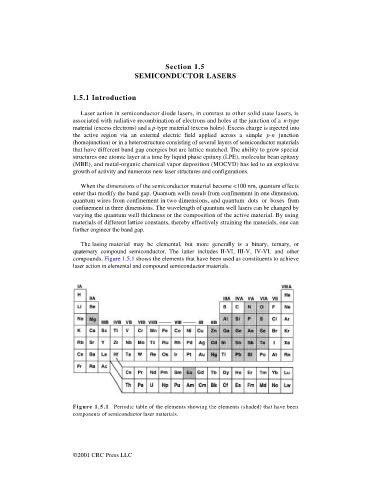
                         compounds. Figure 1.5.1 shows the elements that have been used as constituents to achieve
                         laser action in elemental and compound semiconductor materials.


                         Figure 1.5.1   Periodic table of the elements showing the elements (shaded) that have been
                         components of semiconductor laser materials.


                         ©2001 CRC Press LLC

