


Page 416 - Industrial Ventilation Design Guidebook
P. 416
6.2 OCCUPATIONAL EXPOSURE LIMIT VALUES                                    37 !

                     * The calculations that yield the occupational exposure concentration
                       from the individual analytical values
                     « The jobs to be monitored
                     The measuring procedure used must be appropriate to the chemical agent
                  to be measured, its limit value, and the workplace atmosphere so that the re-
                  sults show the concentration of the agent in the same terms as the limit value,
                  Also, the limits of detection, sensitivity, and precision of the measuring proce-
                  dure must be appropriate to the limit value.
                     The sampling period and interval of sampling are related to concentration
                  patterns and to the method of analysis used.
                     For the sampling location, fixed-point measurement may be used if the re-
                  sults make it possible to assess exposure of the worker at the workplace. In
                  general, however, personal sampling devices are preferred, which give more
                  representative results of worker exposure.
                     Recently in the surveillance of exposed workers, it has proved useful to
                  carry out analysis of the harmful compound or its metabolites using biological
                  material or a change of biochemical parameters caused by the harmful chemi-
                  cal or its metabolites.
                     The coordination of ambient chemical agents and biochemical analyses of
                  exposed workers and medical data is intended to confirm the validity of risk
                  assessment.
                  6.2.4.2 Calculation of the Occupational Exposure Concentration
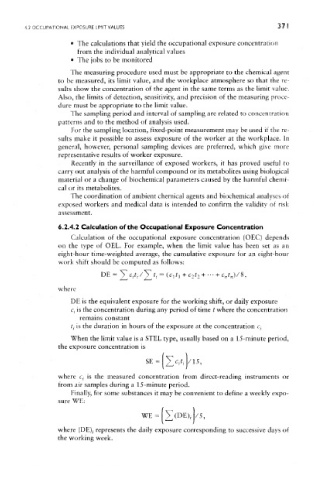
                     Calculation of the occupational exposure concentration (OEC) depends
                  on the type of OEL. For example, when the limit value has been set as an
                  eight-hour time-weighted average, the cumulative exposure for an eight-hour
                  work shift should be computed as follows:


                  where
                     DE is the equivalent exposure for the working shift, or daily exposure
                     c t is the concentration during any period of time t where the concentration
                        remains constant
                     tj is the duration in hours of the exposure at the concentration c,

                     When the limit value is a STEL type, usually based on a 15-minute period,
                  the exposure concentration is


                  where c; ? is the measured concentration from direct-reading instruments or
                  from air samples during a 15-minute period.
                     Finally, for some substances it may be convenient to define a weekly expo-
                  sure WE:


                  where (DE), represents the daily exposure corresponding to successive days of
                  the working week.

