


Page 419 - Industrial Ventilation Design Guidebook
P. 419
3 74                                                        CHAPTER 6 TARGET LEVELS

                      This section deals with the ISO standards, which have been or are be-
                  ing prepared by ISO/TCI59/SC5/WG1 and CEN/TC122/WG11. An over-
                  view of the standards issued and the documents under preparation is given
                  in Table 6.2. CEN Technical Report CR 1752 will also be used in this sec-
                      1
                  tion.  Several of these standards may be used as the basts for the design
                  and evaluation of buildings, HVAC (heating, ventilation, and air condi-
                  tioning) systems, and protective equipment (clothing) and the optimization
                  of work/rest schedules.
                      The basic philosophy has been to standardize evaluation methods, with
                  recommended limit values for the different parameters or indices listed in in-
                  formative annexes. These or other values may then be adapted in national
                  rules for the thermal environment.


        6.3.2 The Thermal Environment
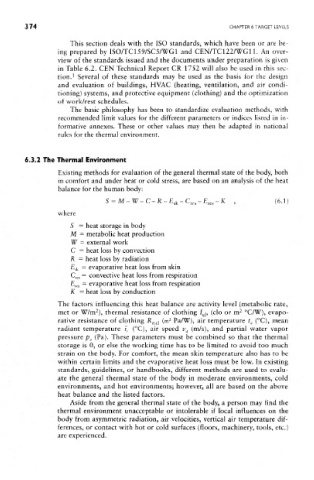
                  Existing methods for evaluation of the general thermal state of the body, both
                  in comfort and under heat or cold stress, are based on an analysis of the heat
                  balance for the human body:


                  where
                      S = heat storage in body
                      M = metabolic heat production
                      W = external work
                      C = heat loss by convection
                      R = heat loss by radiation
                      E sk = evaporative heat loss from skin
                      C res = convective heat loss from respiration
                      E res = evaporative heat loss from respiration
                      K — heat loss by conduction
                  The factors influencing this heat balance are activity level (metabolic rate,
                             2                                         2
                  met or W/m ), thermal resistance of clothing 7 cl, (clo or m  °C/W), evapo-
                                                  2
                  rative resistance of clothing R ec j (m  Pa/W), air temperature t a (°C), mean
                  radiant temperature t r (°C), air speed v a (m/s), and partial water vapor
                  pressure p a (Pa). These parameters must be combined so that the thermal
                  storage is 0, or else the working time has to be limited to avoid too much
                  strain on the body. For comfort, the mean skin temperature also has to be
                  within certain limits and the evaporative heat loss must be low. In existing
                  standards, guidelines, or handbooks, different methods are used to evalu-
                  ate the general thermal state of the body in moderate environments, cold
                  environments, and hot environments; however, all are based on the above
                  heat balance and the listed factors.
                     Aside from the general thermal state of the body, a person may find the
                  thermal environment unacceptable or intolerable if local influences on the
                  body from asymmetric radiation, air velocities, vertical air temperature dif-
                  ferences, or contact with hot or cold surfaces (floors, machinery, tools, etc.)
                  are experienced.

