


Page 417 - Industrial Ventilation Design Guidebook
P. 417
3 72                                                        CHAPTER 6 TARGET LEVELS

                     The daily or weekly exposure should not exceed the eight-hour time-
                  weighted average OEL for the chemical agent involved, and exposure peaks
                  that may occur during the shift must fulfill the STEL; that is, any measured
                  short exposure, SE, during the whole working shift must be lower than the
                  STEL for that agent, if any.
                      If workers are exposed simultaneously or successively to more than one
                  chemical agent, the risk shall be assessed on the basis of the risk presented by all
                  such chemical agents in combination. Usually, additive effects are assumed for the
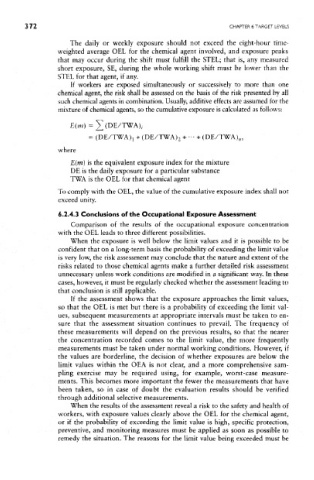
                  mixture of chemical agents, so the cumulative exposure is calculated as follows:


                  where

                      E(m] is the equivalent exposure index for the mixture
                      DE is the daily exposure for a particular substance
                      TWA is the OEL for that chemical agent
                  To comply with the OEL, the value of the cumulative exposure index shall not
                  exceed unity.

                  6.2.4.3 Conclusions of the Occupational Exposure Assessment
                      Comparison of the results of the occupational exposure concentration
                  with the OEL leads to three different possibilities.
                      When the exposure is well below the limit values and it is possible to be
                  confident that on a long-term basis the probability of exceeding the limit value
                  is very low, the risk assessment may conclude that the nature and extent of the
                  risks related to those chemical agents make a further detailed risk assessment
                  unnecessary unless work conditions are modified in a significant way. In these
                  cases, however, it must be regularly checked whether the assessment leading to
                  that conclusion is still applicable.
                      If the assessment shows that the exposure approaches the limit values,
                  so that the OEL is met but there is a probability of exceeding the limit val-
                  ues, subsequent measurements at appropriate intervals must be taken to en-
                  sure that the assessment situation continues to prevail. The frequency of
                  these measurements will depend on the previous results, so that the nearer
                  the concentration recorded comes to the limit value, the more frequently
                  measurements must be taken under normal working conditions. However, if
                  the values are borderline, the decision of whether exposures are below the
                  limit values within the OEA is not clear, and a more comprehensive sam-
                  pling exercise may be required using, for example, worst-case measure-
                  ments. This becomes more important the fewer the measurements that have
                  been taken, so in case of doubt the evaluation results should be verified
                  through additional selective measurements.
                      When the results of the assessment reveal a risk to the safety and health of
                  workers, with exposure values clearly above the OEL for the chemical agent,
                  or if the probability of exceeding the limit value is high, specific protection,
                  preventive, and monitoring measures must be applied as soon as possible to
                  remedy the situation. The reasons for the limit value being exceeded must be

