


Page 439 - Introduction to AI Robotics
P. 439
422
                                                                                  Localization and Map Making
                                                                               11


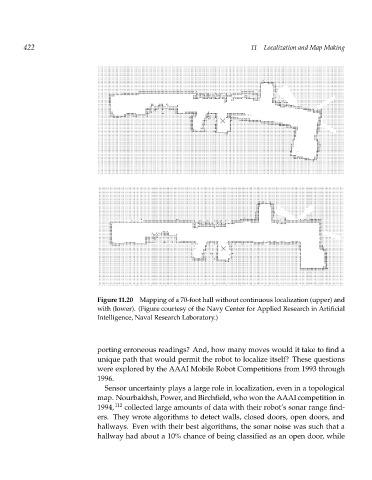
                                     Figure 11.20  Mapping of a 70-foot hall without continuous localization (upper) and
                                     with (lower). (Figure courtesy of the Navy Center for Applied Research in Artificial
                                     Intelligence, Naval Research Laboratory.)


                                     porting erroneous readings? And, how many moves would it take to find a
                                     unique path that would permit the robot to localize itself? These questions
                                     were explored by the AAAI Mobile Robot Competitions from 1993 through
                                     1996.
                                       Sensor uncertainty plays a large role in localization, even in a topological
                                     map. Nourbakhsh, Power, and Birchfield, who won the AAAI competition in
                                     1994, 112  collected large amounts of data with their robot’s sonar range find-
                                     ers. They wrote algorithms to detect walls, closed doors, open doors, and
                                     hallways. Even with their best algorithms, the sonar noise was such that a
                                     hallway had about a 10% chance of being classified as an open door, while

