


Page 174 - Introduction to Information Optics
P. 174
Exercises                         159

               transform lens is 100mm, what would be the allowable transversal
               shift of the object?
       2.36 An input transparency contains several 5 mm targets. If targets are to be
            detected with the white light processor of Fig. 2.44,
            (a) Calculate the required source size. Assume that the focal length of the
               transform lenses is / = 500 mm.
            (b) If the spatial frequency of the input object is assumed to be 10 lines
               per millimeter, calculate the width of the spatial filter H n and the
               required spatial frequency of the sampling phase grating.
       2.37 Assume that the light source of Fig. 2.44 is a point source. If we ignore
            the input signal transparency,
            (a) Determine the smeared length of the Fourier spectra as a function of
               the focal length / of the achromatic transform lens and the spatial
               frequency p 0 of the sinusoidal phase grating T(x).
            (b) If the spatial frequency of the diffraction grating is p 0 = 807i rad/mm
               and / — 30 cm, compute the smeared length of the rainbow color
               spectrum.
       2.38 Referring to the preceding exercise, if the white light source is a uniformly
            circular extended source of diameter D,
            (a) Determine the size of the smeared Fourier spectra as a function of /
               and p 0.
            (b) If D = 2 mm, p 0 = 807i rad/mm, and / = 30 cm, determine the precise
               size of the smeared Fourier spectra.
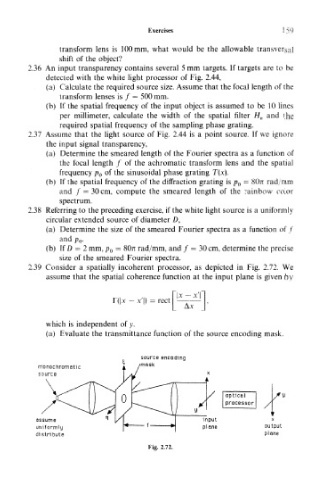
       2.39 Consider a spatially incoherent processor, as depicted in Fig. 2.72. We
            assume that the spatial coherence function at the input plane is given by


                             F(|.x      rect

            which is independent of y.
            (a) Evaluate the transmittance function of the source encoding mask.

                                    source encoding
          monochromatic            /mask
          source


         assume                                    input             X
         uniformly                                 plane           output
         distribute                                                plane
                                      Fig. 2.72.

