


Page 564 - Introduction to Information Optics
P. 564
9.6. Optical Implementation             549

       It is obvious that the carry-lookahead addition used in the number conversion
       process is also applicable for the fast addition of two numbers. When only two
       numbers are added, it is preferable to use carry-lookahead addition directly
       because two-step carry-free addition requires number conversion from NSD
       to the normal negabinary, which takes the same time as carry-lookahead
       addition.


       9.6. OPTICAL IMPLEMENTATION


         The parallel algorithms and architectures described above have been imple-
       mented optically in different ways. In this section, three examples of arithmetic-
       logic operations are shown for implementations of symbolic substitution,
       CAM, and logic array processing. Symbolic substitution is realized through
       M-V multiplication and is usually achieved with coherent correlators. An
       incoherent optical correlator-based shared-CAM (SCAM) is used for imple-
       menting simplified two-step QSD addition [73], and an optical logic array
       processor using an electron-trapping device is demonstrated for parallel
       implementation of two-step NSD addition and subtraction [162]. The other
       arithmetic-logic operations can be implemented similarly.


       9.6.1. SYMBOLIC SUBSTITUTION IMPLEMENTED BY
            MATRIX-VECTOR OPERATION

         To show how symbolic substitution can be realized by matrix -vector
       multiplication (Sec. 9.2.5), an example is illustrated here. Consider the second-
       step substitution rules in the receded or nonrecoded TSD addition (Sec.
       9.4.3.1) [152]. The digits_to_be added are both from the set (I, 0, 1} and their
       sum belongs to the set (2,1, 0, 1, 2}. We use the symbols o, z, ob, t, and tb to
       represent the input pixel patterns for 1, 0, T, 2, and 2, respectively. The nine
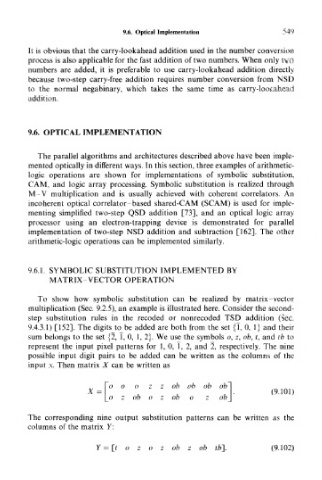
       possible input digit pairs to be added can be written as the columns of the
       input x. Then matrix X can be written as

                           o o    o  z z ob ob ob ob
                      X =                                           (9.101)
                           o z ob o z ob        o   z  ob

       The corresponding nine output substitution patterns can be written as the
       columns of the matrix Y:


                        Y = [t o z o z ob z ob tb].                 (9.102)

