


Page 567 - Introduction to Information Optics
P. 567
9. Computing with Optics

                             IMiii l


                             3   2   1   0   1   2  3


                                       (a)


             3   2   1   o   1   2   3       i2 d| 3             «


                                      (b )

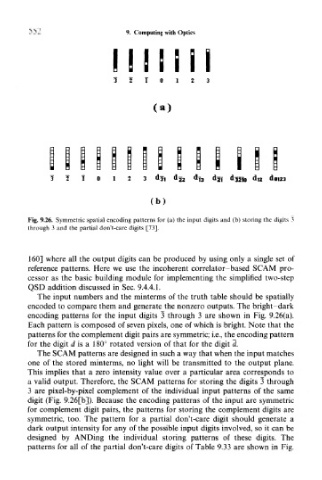
        Fig. 9.26. Symmetric spatial encoding patterns for (a) the input digits and (b) storing the digits
        through 3 and the partial don't-care digits [73].


        160] where all the output digits can be produced by using only a single set of
        reference patterns. Here we use the incoherent correlator-based SCAM pro-
        cessor as the basic building module for implementing the simplified two-step
        QSD addition discussed in Sec. 9.4.4.1.
          The input numbers and the minterms of the truth table should be spatially
        encoded to compare them and generate the nonzero outputs. The bright-dark
        encoding patterns for the input digits 3 through 3 are shown in Fig. 9.26(a).
        Each pattern is composed of seven pixels, one of which is bright. Note that the
        patterns for the complement digit pairs are symmetric; i.e., the_encoding pattern
        for the digit d is a 180° rotated version of that for the digit d.
          The SCAM patterns are designed in such a way that when the input matches
        one of the stored minterms, no light will be transmitted to the output plane.
        This implies that a zero intensity value over a particular area corresponds to
        a valid output. Therefore, the SCAM patterns for storing the digits 3 through
        3 are pixel-by-pixel complement of the individual input patterns of the same
        digit (Fig. 9.26[b]). Because the encoding patterns of the input are symmetric
        for complement digit pairs, the patterns for storing the complement digits are
        symmetric, too. The pattern for a partial don't-care digit should generate a
        dark output intensity for any of the possible input digits involved, so it can be
       designed by ANDing the individual storing patterns of these digits. The
        patterns for all of the partial don't-care digits of Table 9.33 are shown in Fig.

