


Page 348 - Introduction to Marine Engineering
P. 348
Instrumentation  and control  32!

         The  timing of certain events, such  as the opening and  closing of steam
         valves,  must  be  carefully  controlled  to  avoid  dangerous  conditions
         occurring or  to allow other  system adjustments to occur. Protection and
         safety  circuits  or  interlocks would  be  input  to  the  programming  and
         timing unit  to stop  its action if, for  example, the  turning gear  was still
         engaged  or  the  lubricating  oil  pressure  was  low. The  ahead/astern
         selector would direct signals to the appropriate  valve controller resulting
         in  valve actuation  and  steam supply. When manoeuvring some switching
         arrangement  would  ensure  that  the  astern  guardian  valve  was open,
         bled  steam  was  shut  off,  etc.  If  the  turbine  were  stopped  it would
         automatically receive  blasts of steam at timed intervals to prevent rotor
         distortion, A feedback signal of shaft  speed would ensure correct  speed
         without  action  from  the  main  control station.


                                             Safety
                                             checks


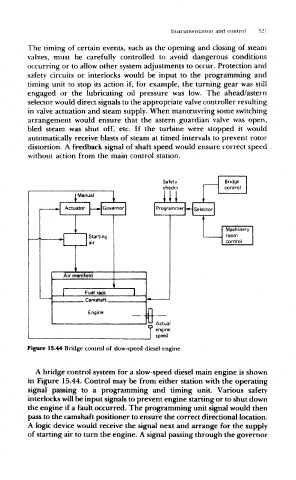
         Figure  15.44  Bridge  control  of  slow-speed  diesel  engine

           A bridge control system for a slow-speed  diesel main engine is shown
         in  Figure  15.44. Control  may be from  either  station  with  the  operating
         signal  passing  to  a  programming  and  timing  unit.  Various  safety
         interlocks will be input signals to prevent engine starting or to shut down
         the engine if a fault occurred. The  programming unit signal would then
         pass to the camshaft positioner  to ensure the correct directional  location.
         A logic device would receive the  signal next and arrange for  the supply
         of starting air to turn the engine. A signal passing through the  governor

