


Page 349 - Introduction to Marine Engineering
P. 349
322   Instrumentation and control


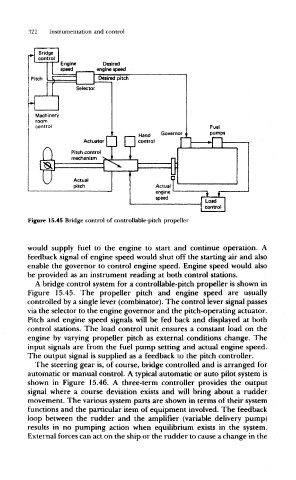
                 Figure  15.45  Bridge  control  of controllable-pitch  propeller


                 would  supply  fuel  to  the  engine  to  start  and  continue  operation.  A
                 feedback  signal of engine  speed would shut off the starting air and  also
                 enable the  governor  to control engine  speed.  Engine  speed  would  also
                 be provided  as an instrument reading  at both  control  stations.
                   A bridge control system for  a controllable-pitch  propeller is shown in
                 Figure  15.45.  The  propeller  pitch  and  engine  speed  are  usually
                 controlled by a single lever (combinator). The  control lever signal  passes
                 via the selector to the engine governor  and the pitch-operating  actuator.
                 Pitch  and  engine  speed  signals will  be  fed  back and  displayed  at  both
                 control  stations. The  load  control  unit ensures  a constant  load  on  the
                 engine  by varying propeller  pitch  as external  conditions  change.  The
                 input  signals are  from  the  fuel  pump  setting and  actual  engine  speed.
                 The  output  signal is supplied  as a feedback to  the  pitch  controller.
                   The  steering gear  is, of course,  bridge  controlled  and  is arranged  for
                 automatic or manual control.  A typical automatic  or auto pilot system is
                 shown  in  Figure  15.46.  A  three-term  controller  provides  the  output
                 signal  where  a  course  deviation  exists  and  will  bring  about  a  rudder
                 movement. The  various system parts are shown in terms  of their system
                 functions  and  the particular item of equipment  involved. The  feedback
                 loop  between  the  rudder  and  the  amplifier  (variable delivery  pump)
                 results  in  no  pumping  action  when  equilibrium exists  in  the  system.
                 External forces can act on the ship or the rudder to cause a change in the

