


Page 352 - Introduction to Marine Engineering
P. 352
Instrumentation  and  control

                 ship's  actual  course  resulting  in  a  feedback  to  the  controller  and
                 subsequent  corrective  action.  The  controller  action  must  be  correctly
                 adjusted  for  the  particular  external conditions to ensure  that excessive
                 rudder  movement does  not occur.


                 Electrical supply control
                 The  automatic  provision  of  electrical  power  to  meet  varying  load
                 demands  can  be  achieved  by  performing  the  following  functions
                 automatically:

                 1.  Prime mover  start  up.
                 2.  Synchronising  of  incoming  machine  with  bus-bars.
                 3.  Load  sharing  between  alternators,
                 4.  Safety  and  operational  checks  on  power  supply  and  equipment  in
                    operation.
                 5.  Unloading,  stopping  and  returning  to standby of surplus  machines.
                 6.  Preferential  tripping  of  non-essential  loads  under  emergency
                    conditions and  their  reinstating when  acceptable.
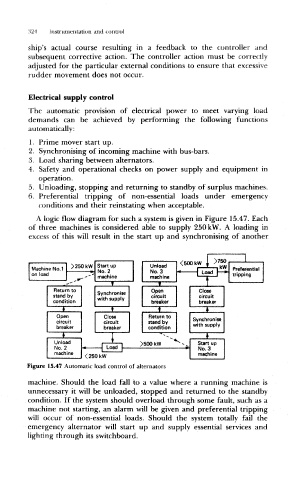
                   A  logic flow  diagram  for  such  a system  is given in  Figure  15.47. Each
                 of  three  machines  is considered  able  to  supply  250 kW.  A  loading  in
                 excess  of  this  will  result  in  the  start  up  and  synchronising  of  another


                                                                  >750,    1   .
                                                         <500kW  ,
                            >250kW Start up      Unload
                  Machine No.1   1  »» No. 2     No. 3   «    j   .  |kW  Preferential
                  on load          machine       machine       Lo 2r!,,J  tripping
                             ^v"                                I
                         , r*' *•"     T
                        ....                       •
                        Return to                 Open        Close
                       stand by    Synchronise    circuit     circuit
                                   with supply
                       condition                  breaker     breaker
                          t            '  1        »             •
                        Open         Close       Return to      '
                        circuit      circuit     stand by    Synchronise
                        breaker      breaker     condition   with supply
                          t                         '- v         \
                                                                '
                        Unload         \-—\    >500 kW  *^ - „  Start up
                        No. 2  «    J L oad  1    —        »•  No. 3
                        machine                               machine
                                <250kW
                Figure  15,47 Automatic load control of alternators
                 machine.  Should  the  load  fall  to  a  value  where  a  running  machine  is
                 unnecessary  it  will  be  unloaded,  stopped  and  returned  to  the  standby
                 condition.  If  the  system should  overload  through  some  fault,  such  as a
                 machine  not  starting,  an  alarm  will  be  given  and  preferential  tripping
                 will  occur  of  non-essential  loads.  Should  the  system  totally  fail  the
                 emergency  alternator  will  start  up  and  supply  essential  services  and
                 lighting through  its switchboard.

