


Page 355 - Introduction to Marine Engineering
P. 355
Engineering materials  327

          applications.  For  measurement  purposes a number  of  terms  are  used,
          with  'stress'  and  'strain'  being  the  most  common.  Stress,  or  more
          correctly  "intensity  of  stress',  is the  force  acting on  a  unit  area  of  the
          material.  Strain  is the  deforming  of  a  material  due  to  stress.  When a
          force is applied  to a material which tends to shorten  or compress it, the
          stress  is termed  'compressive  stress'.  When  the  force  applied  tends  to
          lengthen the material it is termed 'tensile stress'. When the force tends to
          cause  the  various  parts  of  the  material  to  slide  over  one  another  the
          stress is termed  'shear  stress'.

          Tensile test

          A  tensile  test  measures  a  material's  strength  and  ductility. A  specially
          shaped  specimen  of  standard  size  is  gripped  in  the jaws  of  a  testing
          machine, and a load  gradually applied to draw the ends of the  specimen
          apart  such that it is subject to  tensile  stress.  The  original  test  length of
          the specimen, LI, is known and  for each applied  load the new length,  L-2,
          can be measured. The  specimen  will be found to have extended  by some
          small amount,  Lg—LI.  This  deformation, expressed  as

              extension
            original length
          is known  as the  linear strain.
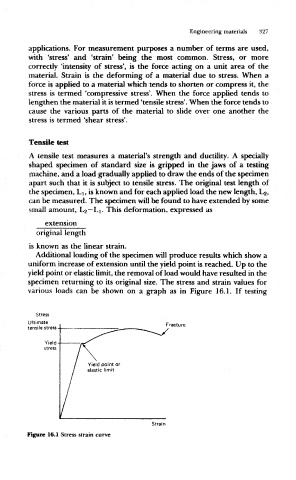
            Additional loading of the  specimen will produce results which show a
          uniform  increase of extension until the yield point is reached.  Up to the
          yield point or elastic limit, the removal of load would have resulted  in the
         specimen  returning to its original size. The  stress and  strain  values for
          various  loads  can  be  shown  on  a  graph  as  in  Figure  16.1.  If  testing


                                              Fracture


                                          Strain
         Figure  16.1 Stress  strain curve

