


Page 357 - Introduction to Marine Engineering
P. 357
Engineering materials  329


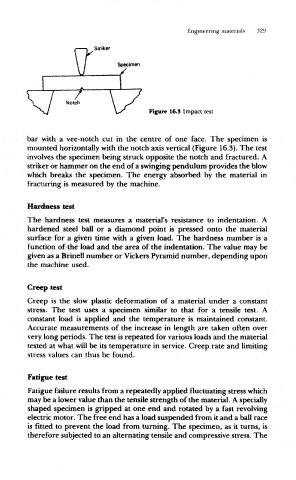
                                          Figure  16.S  Impact  test


         bar  with  a  vee-notch  cut  in  the  centre  of  one  face.  The  specimen  is
         mounted horizontally with the notch axis vertical (Figure  16,3). The  test
         involves the  specimen being struck opposite the  notch  and  fractured. A
         striker or hammer on the end of a swinging pendulum provides the blow
         which  breaks  the  specimen.  The  energy  absorbed  by  the  material  in
         fracturing  is measured  by the  machine.


         The  hardness  test  measures  a  material's  resistance  to  indentation. A
         hardened  steel  ball  or  a  diamond  point  is  pressed  onto  the  material
         surface  for  a  given  time with  a  given  load.  The  hardness  number  is a
         function  of the  load  and  the  area  of the indentation. The  value may be
         given as a Brinell number or Vickers Pyramid number, depending  upon
         the  machine used.

         Creep test

         Creep  is the  slow  plastic  deformation  of  a  material  under  a  constant
         stress.  The  test  uses  a  specimen  similar  to  that  for  a  tensile  test.  A
         constant  load  is applied  and  the  temperature  is  maintained  constant.
         Accurate  measurements of  the  increase  in length  are  taken often  over
         very long periods.  The  test is repeated  for various loads and the  material
         tested  at what will be its temperature in service. Creep  rate  and limiting
         stress values can thus be found.

         Fatigue  test

         Fatigue failure results from a repeatedly  applied fluctuating stress which
         may be a lower value than the tensile strength  of the material. A specially
         shaped  specimen  is gripped  at one  end  and  rotated by a fast  revolving
         electric motor. The  free end has a load  suspended  from it and a ball race
         is  fitted  to prevent  the  load  from turning.  The  specimen, as it turns, is
         therefore subjected  to an alternating tensile and compressive stress.  The

