


Page 145 - Introduction to Mineral Exploration
P. 145
128   J. MILSOM


                                    nT                        require physical contact with the ground and
                                            Total field       can therefore be made from aircraft. Inevitably,
                   (a)                       direction
                                100                           there is some loss of sensitivity, since detectors
                                                              are further from sources, but this may even
                                                              be useful in filtering out local effects from
                                                              manmade objects. The main virtue of airborne
                                                              work is, however, the speed with which large
                                               Magnetic       areas can be covered. Surveys may be flown
                                                              either at a constant altitude or (more com-
                                                              monly in mineral exploration) at a (nominally)
                                    g.u.
                                                              constant height above the ground. Aircraft
                   (b)           10                           are often fitted with multiple sensors and
                                                              most installations include a magnetometer
                                                              (Fig. 7.2).
                                  5
                                                                Airborne surveys require good navigational
                                                              control, both at the time of survey and later,
                                                              when flight paths have to be plotted (recov-
                                                 Gravity      ered). Traditionally, the pilot was guided by a
                                    %                         navigator equipped with maps or photo-mosaics
                   (c)            5                           showing the planned line locations. Course
                                                              changes were avoided unless absolutely neces-
                                                              sary and in many cases the navigator’s main job
                                               Electromagnetic  was to ensure that each line was at least begun
                                 −5                  (CWEM)   in the right place. Although infills were (and
                                                              are) required if lines diverged too much, a line
                                                              that was slightly out of position was preferred
                                                              to one that continually changed direction and
                                    %                         was therefore difficult to plot accurately.
                                                                Low level navigation is not easy, since even
                   (d)            5                           the best landmarks may be visible for only a
                                                              few seconds when flying a few hundred meters
                                                              above the ground, and navigators’ opinions of
                     Electromagnetic                          where they had been would have been very in-
                              (VLF)
                                                              adequate bases for geophysical maps. Tracking
                                 −5
                                                              cameras were therefore used to record images,
                                                              either continuously or as overlapping frames,
                                                              on 35 mm film. Because of the generally small
                                                              terrain clearance, very wide-angle (“fish-eye”)
                                                              lenses were used to give broad, although dis-
                                                              torted, fields of view. Recovery was done dir-
                                                              ectly from the negatives and even the most
                                                              experienced plotters were likely to misidentify
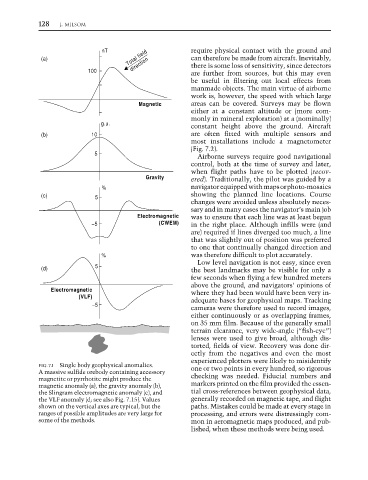
                  FIG. 7.1  Single body geophysical anomalies.  one or two points in every hundred, so rigorous
                  A massive sulfide orebody containing accessory
                  magnetite or pyrrhotite might produce the   checking was needed. Fiducial numbers and
                  magnetic anomaly (a), the gravity anomaly (b),  markers printed on the film provided the essen-
                  the Slingram electromagnetic anomaly (c), and  tial cross-references between geophysical data,
                  the VLF anomaly (d; see also Fig. 7.15). Values  generally recorded on magnetic tape, and flight
                  shown on the vertical axes are typical, but the  paths. Mistakes could be made at every stage in
                  ranges of possible amplitudes are very large for  processing, and errors were distressingly com-
                  some of the methods.                        mon in aeromagnetic maps produced, and pub-
                                                              lished, when these methods were being used.

