


Page 141 - Introduction to Mineral Exploration
P. 141
124   M.K.G. WHATELEY


                   (a)                         (b)


                   (c)                         (d)


                   (e)                         (f)


                   (g)                         (h)


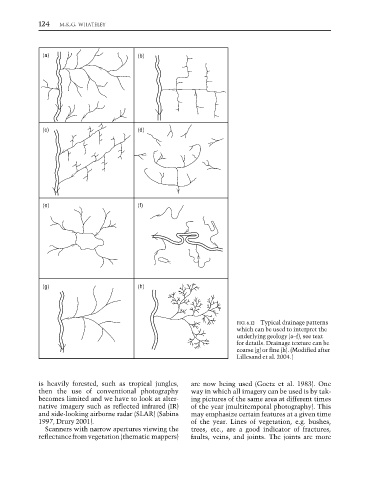
                                                                            FIG. 6.12  Typical drainage patterns
                                                                            which can be used to interpret the
                                                                            underlying geology (a–f), see text
                                                                            for details. Drainage texture can be
                                                                            coarse (g) or fine (h). (Modified after
                                                                            Lillesand et al. 2004.)


                  is heavily forested, such as tropical jungles,  are now being used (Goetz et al. 1983). One
                  then the use of conventional photography    way in which all imagery can be used is by tak-
                  becomes limited and we have to look at alter-  ing pictures of the same area at different times
                  native imagery such as reflected infrared (IR)  of the year (multitemporal photography). This
                  and side-looking airborne radar (SLAR) (Sabins  may emphasize certain features at a given time
                  1997, Drury 2001).                          of the year. Lines of vegetation, e.g. bushes,
                    Scanners with narrow apertures viewing the  trees, etc., are a good indicator of fractures,
                  reflectance from vegetation (thematic mappers)  faults, veins, and joints. The joints are more

