


Page 139 - Introduction to Mineral Exploration
P. 139
122   M.K.G. WHATELEY


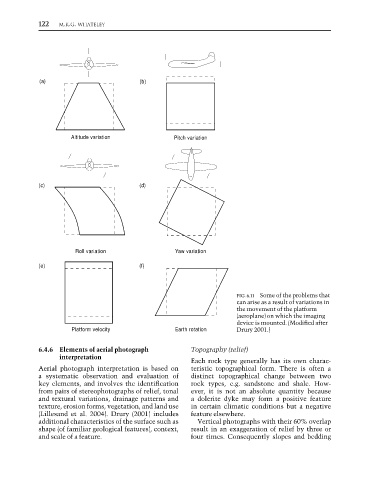
                  (a)                          (b)


                           Altitude variation            Pitch variation


                  (c)                          (d)


                             Roll variation               Yaw variation
                  (e)                          (f)


                                                                            FIG. 6.11  Some of the problems that
                                                                            can arise as a result of variations in
                                                                            the movement of the platform
                                                                            (aeroplane) on which the imaging
                                                                            device is mounted. (Modified after
                           Platform velocity              Earth rotation    Drury 2001.)

                  6.4.6 Elements of aerial photograph         Topography (relief)
                        interpretation
                                                              Each rock type generally has its own charac-
                  Aerial photograph interpretation is based on  teristic topographical form. There is often a
                  a systematic observation and evaluation of  distinct topographical change between two
                  key elements, and involves the identification  rock types, e.g. sandstone and shale. How-
                  from pairs of stereophotographs of relief, tonal  ever, it is not an absolute quantity because
                  and textural variations, drainage patterns and  a dolerite dyke may form a positive feature
                  texture, erosion forms, vegetation, and land use  in certain climatic conditions but a negative
                  (Lillesand et al. 2004). Drury (2001) includes  feature elsewhere.
                  additional characteristics of the surface such as  Vertical photographs with their 60% overlap
                  shape (of familiar geological features), context,  result in an exaggeration of relief by three or
                  and scale of a feature.                     four times. Consequently slopes and bedding

