


Page 135 - Introduction to Mineral Exploration
P. 135
118   M.K.G. WHATELEY


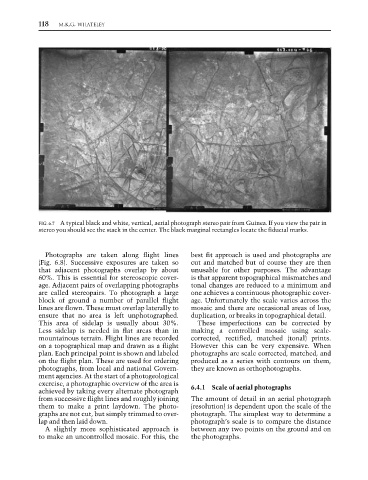
                  FIG. 6.7 A typical black and white, vertical, aerial photograph stereo pair from Guinea. If you view the pair in
                  stereo you should see the stack in the center. The black marginal rectangles locate the fiducial marks.


                    Photographs are taken along flight lines   best fit approach is used and photographs are
                  (Fig. 6.8). Successive exposures are taken so  cut and matched but of course they are then
                  that adjacent photographs overlap by about  unusable for other purposes. The advantage
                  60%. This is essential for stereoscopic cover-  is that apparent topographical mismatches and
                  age. Adjacent pairs of overlapping photographs  tonal changes are reduced to a minimum and
                  are called stereopairs. To photograph a large  one achieves a continuous photographic cover-
                  block of ground a number of parallel flight  age. Unfortunately the scale varies across the
                  lines are flown. These must overlap laterally to  mosaic and there are occasional areas of loss,
                  ensure that no area is left unphotographed.  duplication, or breaks in topographical detail.
                  This area of sidelap is usually about 30%.    These imperfections can be corrected by
                  Less sidelap is needed in flat areas than in  making a controlled mosaic using scale-
                  mountainous terrain. Flight lines are recorded  corrected, rectified, matched (tonal) prints.
                  on a topographical map and drawn as a flight  However this can be very expensive. When
                  plan. Each principal point is shown and labeled  photographs are scale corrected, matched, and
                  on the flight plan. These are used for ordering  produced as a series with contours on them,
                  photographs, from local and national Govern-  they are known as orthophotographs.
                  ment agencies. At the start of a photogeological
                  exercise, a photographic overview of the area is
                  achieved by taking every alternate photograph  6.4.1 Scale of aerial photographs
                  from successive flight lines and roughly joining  The amount of detail in an aerial photograph
                  them to make a print laydown. The photo-    (resolution) is dependent upon the scale of the
                  graphs are not cut, but simply trimmed to over-  photograph. The simplest way to determine a
                  lap and then laid down.                     photograph’s scale is to compare the distance
                    A slightly more sophisticated approach is  between any two points on the ground and on
                  to make an uncontrolled mosaic. For this, the  the photographs.

