


Page 131 - Introduction to Mineral Exploration
P. 131
114   M.K.G. WHATELEY


                  Information extraction                      tion of iron minerals (Fig. 6.6). Similarly a ratio
                                                              of MSS band 6 over band 7 will discrimin-
                  Routines employed for information extraction  ate areas of limonite alteration. Unfortunately
                  use the speed and decision-making capability  limonite also occurs in unaltered sediment-
                  of the computers to classify pixels on some  ary and volcanic rocks. However, by ratioing
                  predetermined gray level. This is carried out  TM bands, mineralogical spectral character-
                  interactively on computers by band ratioing,  istics related to alteration can be detected.
                  multispectral classification, and principal com-  The Landsat TM scanner has two critical,
                  ponent analysis. These can all be used to   additional bands (TM bands 5 and 7), which
                  enhance specific geological features.        are  important in being used to identify hydro-
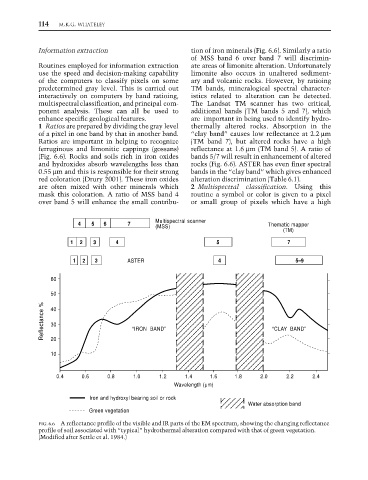
                  1 Ratios are prepared by dividing the gray level  thermally altered rocks. Absorption in the
                  of a pixel in one band by that in another band.  “clay band” causes low reflectance at 2.2 µm
                  Ratios are important in helping to recognize  (TM band 7), but altered rocks have a high
                  ferruginous and limonitic cappings (gossans)  reflectance at 1.6 µm (TM band 5). A ratio of
                  (Fig. 6.6). Rocks and soils rich in iron oxides  bands 5/7 will result in enhancement of altered
                  and hydroxides absorb wavelengths less than  rocks (Fig. 6.6). ASTER has even finer spectral
                  0.55 µm and this is responsible for their strong  bands in the “clay band” which gives enhanced
                  red coloration (Drury 2001). These iron oxides  alteration discrimination (Table 6.1).
                  are often mixed with other minerals which   2 Multispectral classification. Using this
                  mask this coloration. A ratio of MSS band 4  routine a symbol or color is given to a pixel
                  over band 5 will enhance the small contribu-  or small group of pixels which have a high

                                                    Multispectral scanner
                             4   5   6      7                                        Thematic mapper
                                                    (MSS)
                                                                                         (TM)
                           1  2   3     4                             5                   7

                            1  2  3         ASTER                     4                      5–9


                     60
                     50
                   Reflectance %  40         “IRON  BAND”                             “CLAY  BAND”


                     30

                     20
                     10


                       0.4    0.6     0.8    1.0     1.2     1.4    1.6    1.8    2.0     2.2     2.4
                                                         Wavelength (mm)
                                 Iron and hydroxyl bearing soil or rock
                                                                               Water absorption band
                                 Green vegetation
                  FIG. 6.6 A reflectance profile of the visible and IR parts of the EM spectrum, showing the changing reflectance
                  profile of soil associated with “typical” hydrothermal alteration compared with that of green vegetation.
                  (Modified after Settle et al. 1984.)

