


Page 315 - Introduction to Naval Architecture
P. 315
300                VIBRATION, NOISE AND SHOCK

                            18
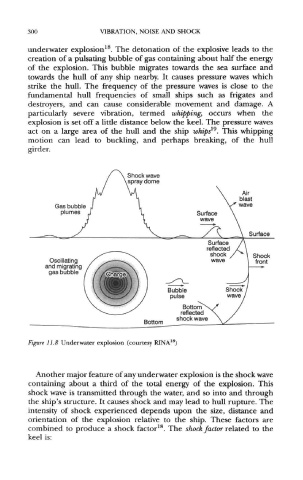
        underwater explosion . The detonation of the explosive leads to the
        creation of a pulsating bubble of gas containing about half the energy
        of the explosion. This bubble migrates towards the sea surface and
        towards the hull of any ship nearby. It causes pressure waves which
        strike the hull. The frequency of the pressure waves is close to the
        fundamental hull frequencies of small ships such as frigates and
        destroyers, and can cause considerable movement and damage. A
        particularly severe vibration, termed whipping, occurs when the
        explosion is set off a litde distance below the keel. The pressure waves
                                                        19
        act on a large area of the hull and the ship whips . This whipping
        motion can lead to buckling, and perhaps breaking, of the hull
        girder.


                                             18
        Figure 11.8 Underwater explosion (courtesy RINA )


          Another major feature of any underwater explosion is the shock wave
        containing about a third of the total energy of the explosion. This
        shock wave is transmitted through the water, and so into and through
        the ship's structure. It causes shock and may lead to hull rupture. The
        intensity of shock experienced depends upon the size, distance and
        orientation of the explosion relative to the ship. These factors are
                                          18
        combined to produce a shock factor . The shock factor related to the
        keel is:

