


Page 316 - Introduction to Naval Architecture
P. 316
VIBRATION, NOISE AND SHOCK                301


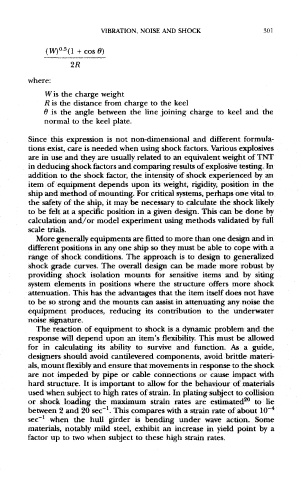
        where:
            Wh the charge weight
            R is the distance from charge to the keel
            0 is the angle between the line joining charge to keel and the
            normal to the keel plate.

        Since this expression is not non-dimensional and different formula-
        tions exist, care is needed when using shock factors. Various explosives
        are in use and they are usually related to an equivalent weight of TNT
        in deducing shock factors and comparing results of explosive testing. In
        addition to the shock factor, the intensity of shock experienced by an
        item of equipment depends upon its weight, rigidity, position in the
        ship and method of mounting. For critical systems, perhaps one vital to
        the safety of the ship, it may be necessary to calculate the shock likely
        to be felt at a specific position in a given design. This can be done by
        calculation and/or model experiment using methods validated by full
        scale trials.
          More generally equipments are fitted to more than one design and in
        different positions in any one ship so they must be able to cope with a
        range of shock conditions. The approach is to design to generalized
        shock grade curves. The overall design can be made more robust by
        providing shock isolation mounts for sensitive items and by siting
        system elements in positions where the structure offers more shock
        attenuation. This has the advantages that the item itself does not have
        to be so strong and the mounts can assist in attenuating any noise the
        equipment produces, reducing its contribution to the underwater
        noise signature.
          The reaction of equipment to shock is a dynamic problem and the
        response will depend upon an item's flexibility. This must be allowed
        for in calculating its ability to survive and function. As a guide,
        designers should avoid cantilevered components, avoid brittle materi-
        als, mount flexibly and ensure that movements in response to the shock
        are not impeded by pipe or cable connections or cause impact with
        hard structure. It is important to allow for the behaviour of materials
        used when subject to high rates of strain. In plating subject to collision
                                                                20
        or shock loading the maximum strain rates are estimated  to lie
                            1                                          4
        between 2 and 20 sec" . This compares with a strain rate of about 10~
           1
        sec"  when the hull girder is bending under wave action. Some
        materials, notably mild steel, exhibit an increase in yield point by a
        factor up to two when subject to these high strain rates.

