


Page 141 - Introduction to Paleobiology and The Fossil Record
P. 141
128  INTRODUCTION TO PALEOBIOLOGY AND THE FOSSIL RECORD


                                                                                                        20
                                                            15
                               33                   1               13         6      7       4
                                                  8
                               33           29         1   2        3  13    5           7        4
                         0              30     9             31                   6            18    19   20
                                             29    8
                         1                                     15                           27
                                                 10  11                28   21  32  22  23
                         2
                        Time (Ma)  3  34               12                        16  17
                                     30
                                            25
                         4
                                                24
                                                    12
                         5
                                             25
                         6
                                  Impalas                            Gnus and hartebeests


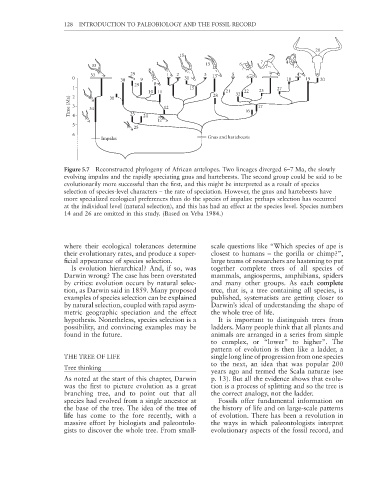
                      Figure 5.7  Reconstructed phylogeny of African antelopes. Two lineages diverged 6–7 Ma, the slowly
                      evolving impalas and the rapidly speciating gnus and hartebeests. The second group could be said to be

                      evolutionarily more successful than the first, and this might be interpreted as a result of species
                      selection of species-level characters – the rate of speciation. However, the gnus and hartebeests have
                      more specialized ecological preferences than do the species of impalas: perhaps selection has occurred
                      at the individual level (natural selection), and this has had an effect at the species level. Species numbers
                      14 and 26 are omitted in this study. (Based on Vrba 1984.)


                      where their ecological tolerances determine     scale questions like “Which species of ape is
                      their evolutionary rates, and produce a super-  closest to humans – the gorilla or chimp?”,
                      ficial appearance of species selection.          large teams of researchers are hastening to put

                        Is evolution hierarchical? And, if so, was    together complete trees of all species of
                      Darwin wrong? The case has been overstated      mammals, angiosperms, amphibians, spiders
                      by critics: evolution occurs by natural selec-  and many other groups. As each  complete
                      tion, as Darwin said in 1859. Many proposed     tree, that is, a tree containing all species, is
                      examples of species selection can be explained   published, systematists are getting closer to
                      by natural selection, coupled with rapid asym-  Darwin’s ideal of understanding the shape of
                      metric geographic speciation and the effect     the whole tree of life.
                      hypothesis. Nonetheless, species selection is a   It is important to distinguish trees from
                      possibility, and convincing examples may be     ladders. Many people think that all plants and
                      found in the future.                            animals are arranged in a series from simple
                                                                      to complex, or “lower” to higher”. The
                                                                      pattern of evolution is then like a ladder, a
                      THE TREE OF LIFE                                single long line of progression from one species
                                                                      to the next, an idea that was popular 200
                      Tree thinking
                                                                      years ago and termed the Scala naturae (see
                      As noted at the start of this chapter, Darwin   p. 13). But all the evidence shows that evolu-
                      was the first to picture evolution as a great    tion is a process of splitting and so the tree is

                      branching tree, and to point out that all       the correct analogy, not the ladder.
                      species had evolved from a single ancestor at     Fossils offer fundamental information on
                      the base of the tree. The idea of the tree of   the history of life and on large-scale patterns
                      life has come to the fore recently, with a      of evolution. There has been a revolution in
                      massive effort by biologists and paleontolo-    the ways in which paleontologists interpret
                      gists to discover the whole tree. From small-   evolutionary aspects of the fossil record, and

