


Page 185 -
P. 185
243_MasterPieces_04a.qxd  4/18/03  7:05 PM  Page 157


                                                                               PneumADDic II • Masterpiece 4   157


                        In Figure 1.4 you can see that switch is flipped to the right, which means the pressure
                    is forced from the left switch port and sent into the base of the piston, forcing the piston
                    to expand.
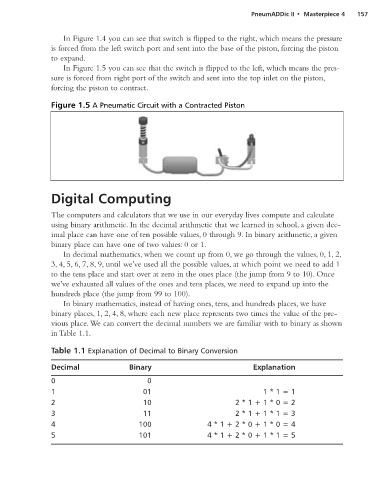
                        In Figure 1.5 you can see that the switch is flipped to the left, which means the pres-
                    sure is forced from right port of the switch and sent into the top inlet on the piston,
                    forcing the piston to contract.

                    Figure 1.5 A Pneumatic Circuit with a Contracted Piston


                    Digital Computing

                    The computers and calculators that we use in our everyday lives compute and calculate
                    using binary arithmetic. In the decimal arithmetic that we learned in school, a given dec-
                    imal place can have one of ten possible values, 0 through 9. In binary arithmetic, a given
                    binary place can have one of two values: 0 or 1.
                        In decimal mathematics, when we count up from 0, we go through the values, 0, 1, 2,
                    3, 4, 5, 6, 7, 8, 9, until we’ve used all the possible values, at which point we need to add 1
                    to the tens place and start over at zero in the ones place (the jump from 9 to 10). Once
                    we’ve exhausted all values of the ones and tens places, we need to expand up into the
                    hundreds place (the jump from 99 to 100).
                        In binary mathematics, instead of having ones, tens, and hundreds places, we have
                    binary places, 1, 2, 4, 8, where each new place represents two times the value of the pre-
                    vious place. We can convert the decimal numbers we are familiar with to binary as shown
                    in Table 1.1.

                    Table 1.1 Explanation of Decimal to Binary Conversion

                    Decimal                Binary                               Explanation

                    0                            0
                    1                          01                                  1 * 1 = 1
                    2                          10                          2 * 1 + 1 * 0 = 2
                    3                          11                          2 * 1 + 1 * 1 = 3
                    4                         100                 4 * 1 + 2 * 0 + 1 * 0 = 4
                    5                         101                 4 * 1 + 2 * 0 + 1 * 1 = 5

