


Page 216 -
P. 216
243_MasterPieces_04b.qxd  4/18/03  7:07 PM  Page 188


           188    Masterpiece 4 • PneumADDic II


                  The Carry Memory


                  The original PneumADDic had only half the pneumatic adding circuitry that
                  PneumADDic II does.To perform the addition for a given binary column, we need to
                  add a bit from Value 1, a bit from Value 2 and the Carry.This is easily done in a two-stage
                  addition, where we add a bit from Value 1 and a bit from Value 2 to get a partial-sum.We
                  then add the partial-sum to the Carry to get the final sum.
                      The original PneumADDic had one two-bit adder, so the complete addition for a
                  given binary place had to be done as two consecutive pneumatic additions.The original
                  PneumADDic also had to electronically remember the carry from binary place to binary
                  place. PneumADDic II contains a complete two-stage pneumatic adding circuit, so a bit
                  from Value 1 and a bit from Value 2 and the Carry can be collectively added together in a
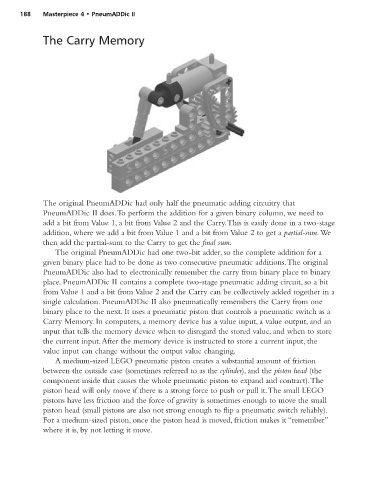
                  single calculation. PneumADDic II also pneumatically remembers the Carry from one
                  binary place to the next. It uses a pneumatic piston that controls a pneumatic switch as a
                  Carry Memory. In computers, a memory device has a value input, a value output, and an
                  input that tells the memory device when to disregard the stored value, and when to store
                  the current input.After the memory device is instructed to store a current input, the
                  value input can change without the output value changing.
                      A medium-sized LEGO pneumatic piston creates a substantial amount of friction
                  between the outside case (sometimes referred to as the cylinder), and the piston head (the
                  component inside that causes the whole pneumatic piston to expand and contract).The
                  piston head will only move if there is a strong force to push or pull it.The small LEGO
                  pistons have less friction and the force of gravity is sometimes enough to move the small
                  piston head (small pistons are also not strong enough to flip a pneumatic switch reliably).
                  For a medium-sized piston, once the piston head is moved, friction makes it “remember”
                  where it is, by not letting it move.

