


Page 241 - Materials Chemistry, Second Edition
P. 241
228   LIFE  CYCLE ASSESSMENT HANDBOOK

              (Wackernagel  & Rees,  1996). Traditional  design  alternatives  aim  to  alleviate
              environmental  strain by modifying  the technological side  of the problem  and
              treating  ecosystems  as  outside  the  boundary  for  improvement.  However,
              reducing the ecological footprint  can also be accomplished  by  modifying  the
              ecosystem  side  of  the  problem.  For  example,  the  most  common  ecosystems
              present in residential areas are lawn and tree systems, both  of which are  effec-
              tive  in  sequestering  carbon  (Singh,  2007), (Nowak,  Crane,  & Stevens, 2006).
              Trees are  also capable  of  removing  pollutants  such  as particulate  matter  and
              NO x  (Nowak, Crane, & Stevens, 2006). In this  context, planting  a tree  on  the
              lawn  of  the house  can be thought  of  as being  similar  to replacing  inefficient
              light bulbs, as they are both solutions to decreasing the environmental  footprint
              of a residential home. Because  of these issues, the residential system is worth
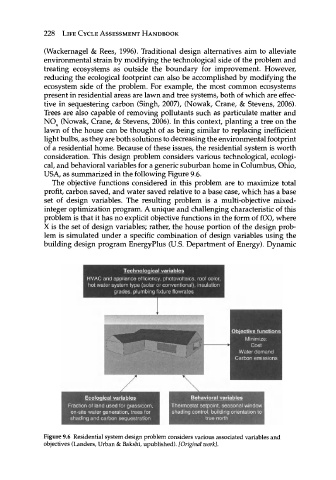
              consideration.  This design  problem  considers  various  technological,  ecologi-
              cal, and behavioral variables for a generic suburban home in Columbus, Ohio,
              USA, as summarized   in the following Figure 9.6.
                 The  objective  functions  considered  in  this  problem  are  to  maximize  total
              profit, carbon saved, and water saved relative to a base case, which has a base
              set  of  design  variables.  The  resulting  problem  is  a  multi-objective  mixed-
              integer optimization program. A unique and  challenging characteristic  of this
              problem is that it has no explicit objective functions  in the form  of f(X), where
              X is the  set  of  design  variables; rather, the house portion  of the  design prob-
              lem  is simulated  under  a  specific  combination  of  design  variables  using  the
              building  design  program  EnergyPlus  (U.S. Department  of  Energy). Dynamic


                                      Technological  variables
                           HVAC and appliance efficiency, photovoltaics,  roof color,
                            hot water system type (solar or conventional),  insulation
                                   grades, plumbing fixture flowrates


                                                                       Objective functions
                                                                           Minimize:
                                                                            Cost
                                                                         Water demand
                                                                        Carbon emissions


                           Ecological variables           Behavioral variables
                     Fraction of land used for grass/corn,   Thermostat setpoint, seasonal window
                      on-site water generation, trees for   shading control, building orientation to
                      shading and carbon sequestration         true north

              Figure  9.6  Residential  system design problem  considers various associated  variables  and
              objectives  (Landers, Urban  & Bakshi, upublished). [Original work].

