


Page 246 - Materials Chemistry, Second Edition
P. 246
234   LIFE CYCLE ASSESSMENT HANDBOOK
                              1
              select and  retain . There is increasing interest and  publication  of theories  and
              case studies related to this concept of managing suppliers and supply chains to
              improve efficiencies,  cost, and environmental and social responsibility  (Krause
              et a\. 2009, Burritt et ah  2011).
                 For  this  reason, the  Purchases  (or  Procurement)  function  can be  critical  in
              a  company's  sustainability  effort.  Through  sustainable  supply  chain  man-
              agement  (SSCM), a company    can  achieve a variety  of  goals, such  as  creating
              more sustainable sources for  their materials, services and  equipment  through
              the  company's  purchasing  policies  and  practices. A recent  literature  review
              identified  multiple  triggers  for  the development  of  SSCM programs,  such  as
              regulation,  customer  demands,  competitive  advantages, and  to  protect  their
              reputation  (Fava et al.  1991). The authors also found  that  SSCM generally  has
              two  distinct  strategies: supplier  management  for  risks and  performance,  and
              supply chain management    for sustainable products. Most  of those  SSCM pro-
              grams  appeared  to  focus  on  environmental  issues,  and  rarely  integrate  the
              three dimensions  of sustainability (environment, social, economic aspects).
                  This  case  study  presents  the  LCA  results  that  triggered  development  of
              P&G Purchases' environmental sustainability approach, how its SSCM system
              integrates the three dimensions  of sustainability, and  current  statistics on the
              sustainability  of  its top  suppliers.  This study  appears  to be  the  largest  of  its
              kind  to  date, revealing  the  current  capability  of  global  supply  chains  to  use
              a variety  of sustainability  metrics and  to find  ways to improve  for  economic,
              social and  environmental  reasons. Data are collected  from  approximately  500
              companies,  large  and  small,  multinational  and  local,  which  represent  more
              than 50% of supplier cost inputs for the materials and services P&G purchases.


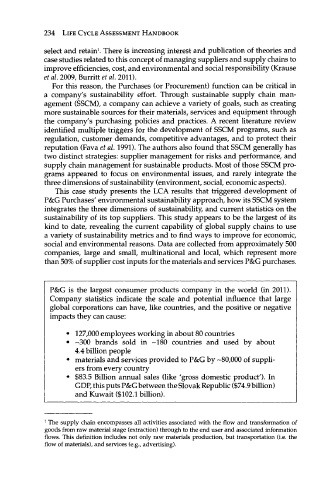
                P&G   is  the  largest  consumer  products  company  in  the  world  (in  2011).
                Company    statistics  indicate  the  scale  and  potential  influence  that  large
                global  corporations  can have, like countries, and  the positive  or  negative
                impacts they can cause:


                     •  127,000 employees working in about  80 countries
                     •  -300  brands  sold  in  -180  countries  and  used  by  about
                        4.4 billion people
                     •  materials and  services provided  to P&G by -80,000  of suppli-
                        ers from  every country
                     •  $83.5  Billion  annual  sales  (like  'gross  domestic  product').  In
                        GDP, this puts P&G between the Slovak Republic ($74.9 billion)
                        and Kuwait  ($102.1 billion).


              1
                The  supply  chain  encompasses  all  activities  associated  with  the  flow  and  transformation  of
              goods  from  raw material  stage  (extraction)  through  to the end user and  associated  information
              flows.  This  definition  includes  not  only  raw  materials  production,  but  transportation  (i.e.  the
              flow  of materials), and  services  (e.g., advertising).

