


Page 248 - Materials Chemistry, Second Edition
P. 248
236   LIFE  CYCLE ASSESSMENT HANDBOOK

              they  contain  information  on  production  processes  and  proprietary  materials
              that they do not want competitors to have. Also, the purpose  of the LCA is to
              inform business decisions. Since those buying the products do not read  scien-
              tific  journals,  less  complex  information  on  the products  is provided  through
              other media.
                 In  2001 and  2010, P&G  compiled  the  results  of  LCAs  for  several kinds  of
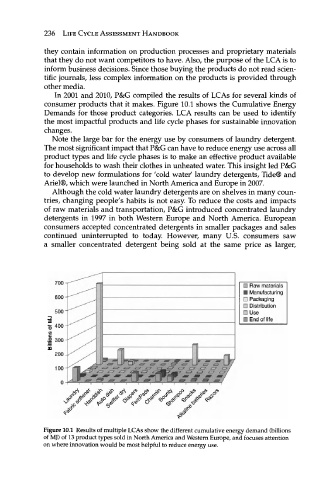
              consumer   products  that  it makes. Figure  10.1 shows  the Cumulative  Energy
              Demands   for  those  product  categories.  LCA results  can  be  used  to  identify
              the most  impactful  products  and  life  cycle phases  for  sustainable  innovation
              changes.
                 Note  the  large bar  for  the  energy  use by  consumers  of  laundry  detergent.
              The most significant  impact that  P&G can have to reduce energy use across all
              product  types and  life  cycle phases  is to make an  effective  product  available
              for households  to wash their clothes in unheated  water. This insight led  P&G
              to develop  new  formulations  for  'cold  water'  laundry  detergents,  Tide® and
              Ariel®, which were launched  in North America and Europe in 2007.
                 Although the cold water laundry detergents are on shelves in many  coun-
              tries, changing  people's  habits  is not  easy.  To reduce  the  costs and  impacts
              of raw  materials  and  transportation,  P&G introduced  concentrated  laundry
              detergents  in  1997 in  both  Western  Europe  and  North  America.  European
              consumers   accepted  concentrated  detergents  in  smaller  packages  and  sales
              continued  uninterrupted   to  today.  However,  many  U.S.  consumers  saw
              a  smaller  concentrated  detergent  being  sold  at  the  same  price  as  larger,


              Figure 10.1  Results  of multiple  LCAs show the different  cumulative  energy demand  (billions
              of MJ) of  13 product  types sold in North America and  Western  Europe, and  focuses  attention
              on where innovation  would  be most helpful  to reduce energy use.

