


Page 264 - Materials Chemistry, Second Edition
P. 264
252   LIFE  CYCLE ASSESSMENT  HANDBOOK

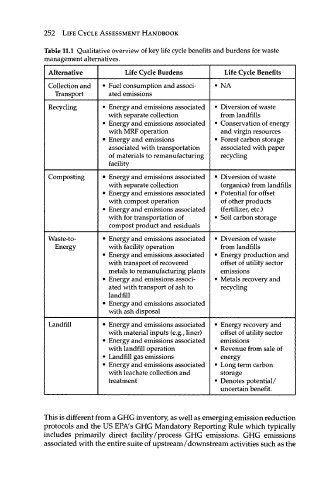
              Table 11.1  Qualitative overview  of key life cycle benefits and burdens for waste
              management alternatives.

                Alternative            Life Cycle  Burdens          Life Cycle  Benefits
                Collection and   •  Fuel consumption and associ-  •  NA
                  Transport       ated  emissions
                Recycling       •  Energy and emissions  associated  •  Diversion  of waste
                                  with separate  collection        from  landfills
                                •  Energy and emissions  associated  •  Conservation  of energy
                                  with MRF operation               and virgin  resources
                                •  Energy and emissions          •  Forest carbon  storage
                                  associated with  transportation  associated with  paper
                                  of materials to  remanufacturing  recycling
                                  facility
                Composting      •  Energy and emissions  associated  •  Diversion  of waste
                                  with separate  collection        (organics) from  landfills
                                •  Energy and emissions  associated  •  Potential for  offset
                                  with compost  operation          of other  products
                                •  Energy and emissions  associated  (fertilizer, etc.)
                                  with for transportation of     •  Soil carbon  storage
                                  compost product and residuals
                Waste-to-       •  Energy and emissions  associated  •  Diversion  of waste
                  Energy          with facility  operation         from  landfills
                                •  Energy and emissions  associated  •  Energy production and
                                  with transport  of recovered     offset  of utility  sector
                                  metals to remanufacturing  plants  emissions
                                •  Energy and emissions  associ-  •  Metals recovery and
                                  ated with transport  of ash to   recycling
                                  landfill
                                •  Energy and emissions  associated
                                  with ash disposal
                Landfill        •  Energy and emissions  associated  •  Energy recovery and
                                  with material inputs  (e.g., liner)   offset  of utility  sector
                                •  Energy and emissions  associated  emissions
                                  with landfill  operation       •  Revenue from  sale of
                                •  Landfill gas emissions          energy
                                •  Energy and emissions  associated  •  Long term  carbon
                                  with leachate collection and     storage
                                  treatment                      •  Denotes  potential/
                                                                   uncertain  benefit.


              This is different  from  a GHG inventory, as well as emerging emission reduction
              protocols and  the US EPA's GHG Mandatory    Reporting  Rule which  typically
              includes  primarily  direct  facility/process  GHG  emissions.  GHG  emissions
              associated with the entire suite of upstream/downstream  activities such as the

