


Page 270 - Materials Chemistry, Second Edition
P. 270
258   LIFE  CYCLE ASSESSMENT HANDBOOK

                 All activities that  have  a bearing  on the management  of  solid  waste,  from
              collection through transportation,  recovery and  separation  of materials, treat-
              ment,  and  disposal,  are  typically  included  in  the  LCA boundaries.  It  is usu-
              ally assumed  that waste material enters the system boundaries when  it is set
              out  (or dropped  off)  for collection. Therefore, the life cycle burdens  associated
              with  the  production  of  garbage  bags,  garbage  cans,  compost  and  recycling
              bins are typically not included  in an  LCA of  end-of-life  management  options.
              Similarly, the transport  of waste by residents to a drop-off  facility  is typically
              not included. It is often assumed that residents stop at waste drop-off  facilities
              on their way to somewhere else.
                 The  functional  elements  of  solid  waste  management  include  numerous
              pieces  of capital equipment,  from  refuse  collection vehicles to balers  for  recy-
              cled  materials  to  major  equipment  at  composting  and  combustion  facilities.
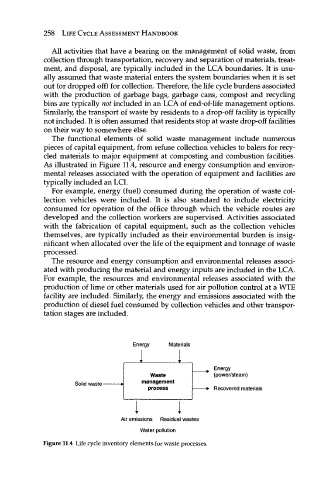
              As illustrated  in  Figure  11.4, resource and  energy  consumption  and  environ-
              mental  releases  associated  with  the operation  of equipment  and  facilities  are
              typically included an LCI.
                 For example, energy  (fuel)  consumed  during  the  operation  of waste  col-
              lection  vehicles  were  included.  It  is  also  standard  to  include  electricity
              consumed   for  operation  of  the  office  through  which  the  vehicle  routes  are
              developed  and  the  collection  workers  are supervised.  Activities  associated
              with  the  fabrication  of  capital  equipment,  such  as  the  collection  vehicles
              themselves,  are  typically  included  as  their  environmental  burden  is  insig-
              nificant  when allocated  over the life  of the equipment and tonnage  of waste
              processed.
                 The resource  and  energy  consumption  and  environmental  releases  associ-
              ated with producing the material and energy inputs are included  in the LCA.
              For  example,  the  resources  and  environmental  releases  associated  with  the
              production  of lime or other  materials used  for  air pollution  control at a WTE
              facility  are included.  Similarly, the energy and  emissions  associated  with  the
              production  of diesel fuel  consumed by collection vehicles and other  transpor-
              tation stages are included.


                                         Energy     Materials


                                           1  f       * r
                                                               ¥  Energy
                                              Waste              (power/steam)
                        Solid waste -       management
                                                              -►  Recovered materials


                                     Air emissions  Residual wastes
                                           Water pollution
              Figure  11.4  Life cycle inventory  elements  for waste  processes.

