


Page 274 - Materials Chemistry, Second Edition
P. 274
262   LIFE  CYCLE ASSESSMENT  HANDBOOK

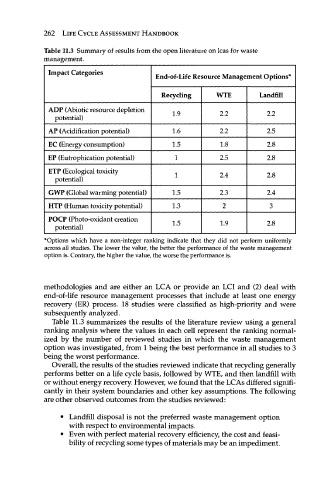
              Table 11.3  Summary  of results from  the open literature on leas for  waste
              management.

                Impact Categories
                                                End-of-Life  Resource Management Options*

                                                 Recycling        WTE          Landfill

                ADP (Abiotic resource depletion      1.9           2.2           2.2
                  potential)

                AP (Acidification  potential)        1.6           2.2           2.5
                EC (Energy consumption)              1.5           1.8           2.8

                EP (Eutrophication potential)        1             2.5           2.8
                ETP (Ecological toxicity             1             2.4           2.8
                  potential)
                GWP (Global warming potential)       1.5           2.3           2.4     ]

                HTP (Human toxicity potential)       1.3            2             3
                POCP (Photo-oxidant  creation        1.5           1.9           2.8
                  potential)
              ^Options  which  have  a  non-integer  ranking  indicate  that  they  did  not  perform  uniformly
              across all studies. The lower the value, the better the performance  of the waste management
              option is. Contrary, the higher the value, the worse the performance is.


              methodologies   and  are  either  an  LCA  or  provide  an  LCI  and  (2)  deal  with
              end-of-life  resource  management  processes  that  include  at  least  one  energy
              recovery  (ER)  process.  18  studies  were  classified  as  high-priority  and  were
              subsequently  analyzed.
                 Table  11.3 summarizes  the  results  of  the  literature  review  using  a  general
              ranking  analysis where  the values  in  each  cell represent  the ranking  normal-
              ized  by  the  number  of  reviewed  studies  in  which  the  waste  management
              option was investigated,  from  1 being the best performance  in all studies to  3
              being the worst  performance.
                 Overall, the results  of the studies reviewed  indicate that recycling  generally
              performs  better  on  a  life  cycle basis, followed  by WTE, and  then  landfill  with
              or without energy recovery. However, we found  that the LCAs differed  signifi-
              cantly  in  their  system  boundaries  and  other  key  assumptions.  The  following
              are other observed  outcomes from  the studies  reviewed:

                   •  Landfill  disposal  is not  the  preferred  waste  management  option
                      with respect to environmental  impacts.
                   •  Even with  perfect  material recovery  efficiency,  the cost and  feasi-
                      bility of recycling some types of materials may be an  impediment.

