


Page 276 - Materials Chemistry, Second Edition
P. 276
264   LIFE CYCLE ASSESSMENT HANDBOOK

                   •  The  environmental  benefits  of  recycling  are  highly  dependent
                      on  the type and  amount  of  material substituted by  the recycla-
                      bles. For example, recycling performs better when it is assumed
                      that  recycled  material  replaces  an  equivalent  amount  of  virgin
                      material.
                   •  The difference  in environmental impact between WTE and recy-
                      cling  decreases  as  higher  waste-to-energy  recovery  efficiencies
                      are  assumed  and  the  energy  generated  replaces  electricity and
                      heat from  fossil fuels instead  of non-fossil fuels. In general, WTE
                      facilities  which  produce  combined  electricity and  heat  perform
                      better than those that only produce electricity or heat.


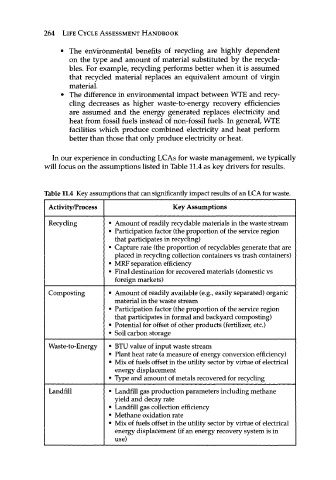
                 In our experience in conducting LCAs for waste management, we typically
              will focus on the assumptions listed in Table 11.4 as key drivers for results.


              Table 11.4  Key assumptions that can significantly impact results of an LCA for waste.
                Activity/Process                     Key  Assumptions

                Recycling         •  Amount  of readily recyclable materials in the waste  stream
                                  •  Participation  factor  (the proportion  of the service region
                                   that participates in  recycling)
                                  •  Capture rate (the proportion  of recyclables generate that  are
                                   placed in recycling collection containers vs trash  containers)
                                  •  MRF separation  efficiency
                                  •  Final destination  for recovered  materials (domestic vs
                                   foreign  markets)
                Composting        •  Amount  of readily available (e.g., easily separated)  organic
                                   material in the waste  stream
                                  •  Participation  factor  (the proportion  of the service region
                                   that participates in formal and backyard  composting)
                                  •  Potential for  offset  of other products  (fertilizer,  etc.)
                                  •  Soil carbon  storage
                Waste-to-Energy   •  BTU value  of input waste  stream
                                  •  Plant heat rate  (a measure  of energy conversion  efficiency)
                                  •  Mix of fuels  offset  in the utility sector by virtue  of  electrical
                                   energy  displacement
                                  •  Type and amount  of metals recovered  for  recycling

                Landfill          •  Landfill  gas production parameters including  methane
                                   yield and decay rate
                                  •  Landfill gas collection  efficiency
                                  •  Methane oxidation  rate
                                  •  Mix  of fuels  offset  in the utility sector by virtue  of  electrical
                                   energy displacement  (if an energy recovery system is in
                                   use)

