


Page 257 - Low Temperature Energy Systems with Applications of Renewable Energy
P. 257
Geothermal energy in combined heat and power systems 243
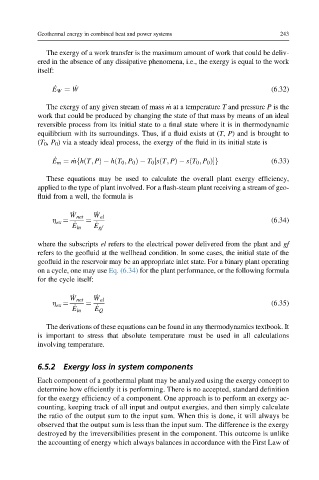
The exergy of a work transfer is the maximum amount of work that could be deliv-
ered in the absence of any dissipative phenomena, i.e., the exergy is equal to the work
itself:
_
E W ¼ W _ (6.32)
The exergy of any given stream of mass _ m at a temperature T and pressure P is the
work that could be produced by changing the state of that mass by means of an ideal
reversible process from its initial state to a final state where it is in thermodynamic
equilibrium with its surroundings. Thus, if a fluid exists at (T, P) and is brought to
(T 0 , P 0 ) via a steady ideal process, the exergy of the fluid in its initial state is
_
E m ¼ _ mfhðT; PÞ hðT 0 ; P 0 Þ T 0 ½sðT; PÞ sðT 0 ; P 0 Þg (6.33)
These equations may be used to calculate the overall plant exergy efficiency,
applied to the type of plant involved. For a flash-steam plant receiving a stream of geo-
fluid from a well, the formula is
_ _
W net W el
h ¼ _ ¼ _ (6.34)
ex
E in E gf
where the subscripts el refers to the electrical power delivered from the plant and gf
refers to the geofluid at the wellhead condition. In some cases, the initial state of the
geofluid in the reservoir may be an appropriate inlet state. For a binary plant operating
on a cycle, one may use Eq. (6.34) for the plant performance, or the following formula
for the cycle itself:
_ _
W net W el
h ¼ _ ¼ _ (6.35)
ex
E in E Q
The derivations of these equations can be found in any thermodynamics textbook. It
is important to stress that absolute temperature must be used in all calculations
involving temperature.
6.5.2 Exergy loss in system components
Each component of a geothermal plant may be analyzed using the exergy concept to
determine how efficiently it is performing. There is no accepted, standard definition
for the exergy efficiency of a component. One approach is to perform an exergy ac-
counting, keeping track of all input and output exergies, and then simply calculate
the ratio of the output sum to the input sum. When this is done, it will always be
observed that the output sum is less than the input sum. The difference is the exergy
destroyed by the irreversibilities present in the component. This outcome is unlike
the accounting of energy which always balances in accordance with the First Law of

