


Page 254 - Low Temperature Energy Systems with Applications of Renewable Energy
P. 254
240                 Low-Temperature Energy Systems with Applications of Renewable Energy


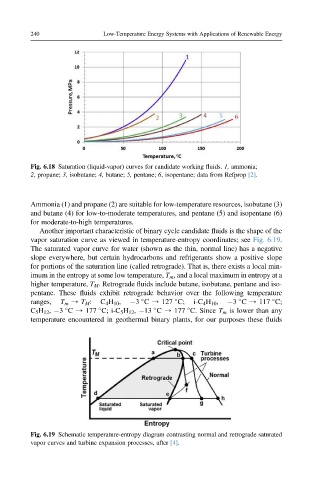
         Fig. 6.18 Saturation (liquid-vapor) curves for candidate working fluids. 1, ammonia;
         2, propane; 3, isobutane; 4, butane; 5, pentane; 6, isopentane; data from Refprop [2].


         Ammonia (1) and propane (2) are suitable for low-temperature resources, isobutane (3)
         and butane (4) for low-to-moderate temperatures, and pentane (5) and isopentane (6)
         for moderate-to-high temperatures.
            Another important characteristic of binary cycle candidate fluids is the shape of the
         vapor saturation curve as viewed in temperature-entropy coordinates; see Fig. 6.19.
         The saturated vapor curve for water (shown as the thin, normal line) has a negative
         slope everywhere, but certain hydrocarbons and refrigerants show a positive slope
         for portions of the saturation line (called retrograde). That is, there exists a local min-
         imum in the entropy at some low temperature, T m , and a local maximum in entropy at a
         higher temperature, T M . Retrograde fluids include butane, isobutane, pentane and iso-
         pentane. These fluids exhibit retrograde behavior over the following temperature


         ranges,  T m / T M :  C 4 H 10 ,   3 C / 127 C;  i-C 4 H 10 ,   3 C / 117 C;


         C 5 H 12 ,  3 C / 177 C; i-C 5 H 12 ,  13 C / 177 C. Since T m is lower than any
         temperature encountered in geothermal binary plants, for our purposes these fluids


         Fig. 6.19 Schematic temperature-entropy diagram contrasting normal and retrograde saturated
         vapor curves and turbine expansion processes, after [4].

