


Page 249 - Low Temperature Energy Systems with Applications of Renewable Energy
P. 249
236                 Low-Temperature Energy Systems with Applications of Renewable Energy


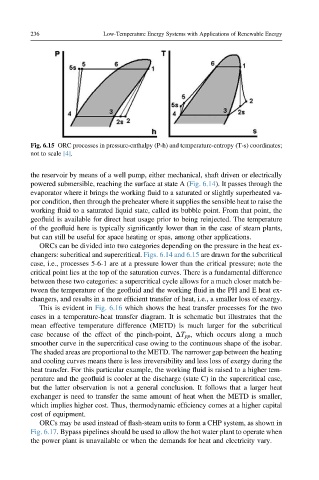
         Fig. 6.15 ORC processes in pressure-enthalpy (P-h) and temperature-entropy (T-s) coordinates;
         not to scale [4].

         the reservoir by means of a well pump, either mechanical, shaft driven or electrically
         powered submersible, reaching the surface at state A (Fig. 6.14). It passes through the
         evaporator where it brings the working fluid to a saturated or slightly superheated va-
         por condition, then through the preheater where it supplies the sensible heat to raise the
         working fluid to a saturated liquid state, called its bubble point. From that point, the
         geofluid is available for direct heat usage prior to being reinjected. The temperature
         of the geofluid here is typically significantly lower than in the case of steam plants,
         but can still be useful for space heating or spas, among other applications.
            ORCs can be divided into two categories depending on the pressure in the heat ex-
         changers: subcritical and supercritical. Figs. 6.14 and 6.15 are drawn for the subcritical
         case, i.e., processes 5-6-1 are at a pressure lower than the critical pressure; note the
         critical point lies at the top of the saturation curves. There is a fundamental difference
         between these two categories: a supercritical cycle allows for a much closer match be-
         tween the temperature of the geofluid and the working fluid in the PH and E heat ex-
         changers, and results in a more efficient transfer of heat, i.e., a smaller loss of exergy.
            This is evident in Fig. 6.16 which shows the heat transfer processes for the two
         cases in a temperature-heat transfer diagram. It is schematic but illustrates that the
         mean effective temperature difference (METD) is much larger for the subcritical
         case because of the effect of the pinch-point, DT pp , which occurs along a much
         smoother curve in the supercritical case owing to the continuous shape of the isobar.
         The shaded areas are proportional to the METD. The narrower gap between the heating
         and cooling curves means there is less irreversibility and less loss of exergy during the
         heat transfer. For this particular example, the working fluid is raised to a higher tem-
         perature and the geofluid is cooler at the discharge (state C) in the supercritical case,
         but the latter observation is not a general conclusion. It follows that a larger heat
         exchanger is need to transfer the same amount of heat when the METD is smaller,
         which implies higher cost. Thus, thermodynamic efficiency comes at a higher capital
         cost of equipment.
            ORCs may be used instead of flash-steam units to form a CHP system, as shown in
         Fig. 6.17. Bypass pipelines should be used to allow the hot water plant to operate when
         the power plant is unavailable or when the demands for heat and electricity vary.

