


Page 246 - Low Temperature Energy Systems with Applications of Renewable Energy
P. 246
Geothermal energy in combined heat and power systems              233


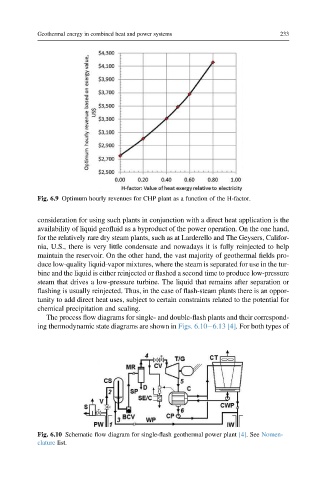
           Fig. 6.9 Optimum hourly revenues for CHP plant as a function of the H-factor.


           consideration for using such plants in conjunction with a direct heat application is the
           availability of liquid geofluid as a byproduct of the power operation. On the one hand,
           for the relatively rare dry steam plants, such as at Larderello and The Geysers, Califor-
           nia, U.S., there is very little condensate and nowadays it is fully reinjected to help
           maintain the reservoir. On the other hand, the vast majority of geothermal fields pro-
           duce low-quality liquid-vapor mixtures, where the steam is separated for use in the tur-
           bine and the liquid is either reinjected or flashed a second time to produce low-pressure
           steam that drives a low-pressure turbine. The liquid that remains after separation or
           flashing is usually reinjected. Thus, in the case of flash-steam plants there is an oppor-
           tunity to add direct heat uses, subject to certain constraints related to the potential for
           chemical precipitation and scaling.
              The process flow diagrams for single- and double-flash plants and their correspond-
           ing thermodynamic state diagrams are shown in Figs. 6.10e6.13 [4]. For both types of


           Fig. 6.10 Schematic flow diagram for single-flash geothermal power plant [4]. See Nomen-
           clature list.

